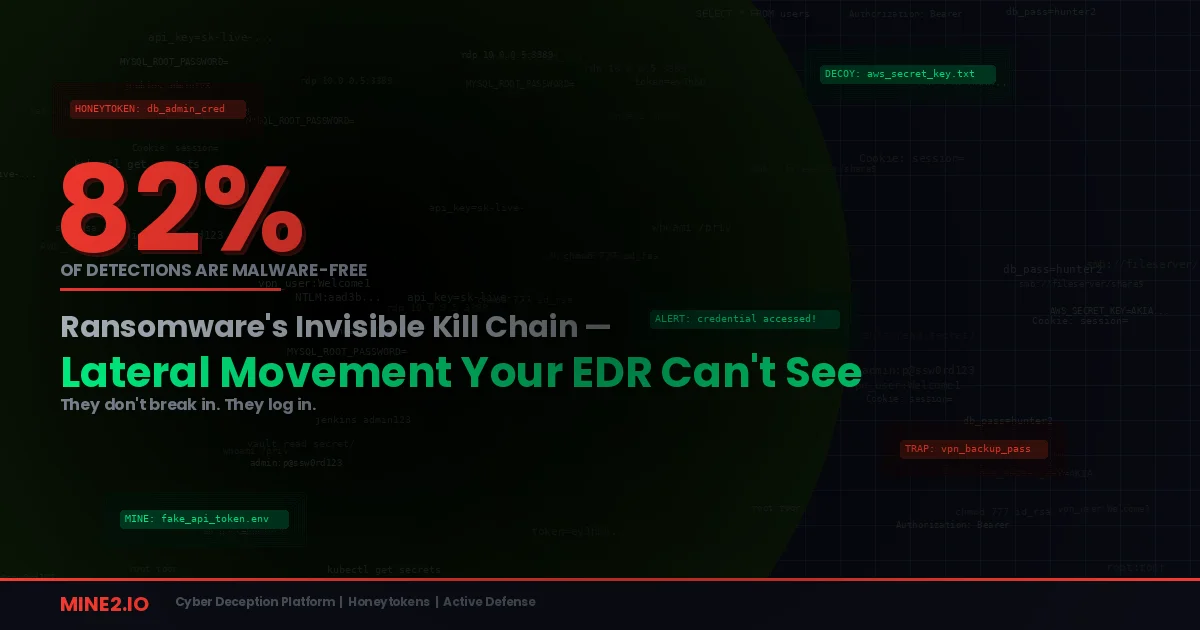
Here's a stat that should keep every CISO up at night: 82% of threat detections in 2025 were malware-free. That's straight from the CrowdStrike 2026 Global Threat Report. No malicious binaries. No exploit signatures. Just adversaries logging in with valid credentials and using your own administrative tools, PowerShell, PsExec, WMI, RDP, to walk through your network undetected.
Ransomware attacks surged 58% in 2025, with over 7,500 victims publicly named on data leak sites. Groups averaged nearly 700 new victims per month in the final quarter. The average cost of a ransomware breach hit $5.08 million. And according to Chainalysis, even as total ransom payments dropped to $820 million (with only 28% of victims paying), the median ransom demand exploded 368% to nearly $60,000. Fewer organizations are paying, but the ones that do are paying far more.
I build detections for a living, so let me be blunt about where this goes wrong. The initial access was survivable. In nearly every major ransomware incident, it's the lateral movement phase, the quiet walk through the network using legitimate tools, that turns one compromised endpoint into a domain-wide catastrophe.
The Living-off-the-Land Playbook: Moving Without Malware
Modern ransomware operators have perfected what the industry calls living-off-the-land (LOTL). Instead of dropping custom malware that EDR is trained to spot, they abuse the same admin utilities your IT team runs every day.
The numbers are grim. Per the Picus Security 2025 Red Report, PowerShell showed up in 71% of all living-off-the-land attacks, the most common post-compromise tool across ransomware families. Sophos found RDP abuse present in 90% of ransomware cases. Legitimate remote management tools, AnyDesk, Atera, ScreenConnect, Splashtop, are getting weaponized across multiple ransomware operations for persistent access.
The CrowdStrike report documents the fallout: average eCrime breakout time collapsed to 29 minutes, with the fastest observed breakout at 27 seconds. Unit 42's data shows the fastest quarter of intrusions reaching exfiltration in 72 minutes in 2025, down from 285 minutes in 2024.
The kill chain is remarkably consistent across groups. Researchers tracking dozens of active operations describe a repeatable pattern: phish the user or buy brokered access, execute via PowerShell, persist with valid accounts or scheduled tasks, move laterally via RDP and PsExec, exfiltrate over C2, delete backups, and encrypt. The whole lateral movement phase relies on tools and protocols that are indistinguishable from normal IT operations.
That's why the shift from exploit-driven breaches to identity-led intrusions matters so much. Darktrace's Annual Threat Report 2026 found that attackers increasingly use legitimate tools and permissions to disguise activity as normal behavior, making lateral movement fast and hard to detect. When PsExec, WinRM, and RDP are the weapons, your detection tools face an impossible job: separating malicious admin activity from legitimate admin activity in real time. I unpacked the broader trend in the rise of the Digital Parasite.
Why Your Current Stack Is Losing This Fight
Let me be direct about the detection gap.
EDR is built for malware, not lateral movement. When a ransomware affiliate uses PsExec to run commands on a remote system, the endpoint sees a legitimate administrative action. No signature to match, no behavioral anomaly to flag, it's the same tool your sysadmin used five minutes earlier. CrowdStrike's own data confirms it: 82% of detections were malware-free. The ecosystem's most effective tactic is the one that renders traditional endpoint detection functionally blind. And when attackers actively disable the agent, you're left with nothing, which is exactly why deception survives EDR killers.
Network monitoring drowns in east-west traffic. Most enterprise networks still lean on perimeter-focused architectures. The internal network is flat, or carved into broad VLANs that don't restrict lateral traffic between devices in the same zone. When an attacker hops from one workstation to another over RDP, it looks exactly like a remote desktop session from an authorized user, because technically it is.
SIEM rules can't keep up with LOTL. The detection gap for living-off-the-land techniques is well-documented. Spearphishing Link (MITRE T1566.002) has one of the most critical detection gaps, with only a handful of Sigma rules despite being used by dozens of threat actors. Seven ATT&CK techniques have no D3FEND defensive mappings at all, concentrated in the Impact, Persistence, and Lateral Movement phases, exactly where ransomware does its damage.
The talent gap amplifies everything. The cybersecurity industry faces a 4.8 million worker shortage globally. SOC teams are drowning in alert fatigue, and 40% of ransomware victims in 2025 cited lack of cybersecurity expertise as a contributing factor to their breach. Another 39% cited insufficient staff or capacity. When your team can't investigate every alert, false-positive-heavy tools become a liability.
The result? Ransomware operators have an average of 73 days of unrestricted access before being removed. And 57% of ransomware incidents in Q4 2024 were first detected by external parties, not the organization's own security team.
How Deception Catches the Movement Detection Can't
Cyber deception solves the lateral movement problem from a different angle entirely. Instead of trying to distinguish malicious LOTL activity from legitimate administration, an increasingly impossible task, deception places decoy assets along the paths attackers have to traverse. Any interaction with a decoy is, by definition, unauthorized.
Zero noise. Zero false positives. Immediate, high-fidelity signal that someone is moving where they shouldn't.
Decoy Services Become Tripwires for Reconnaissance
The first thing a ransomware affiliate does after gaining access is reconnaissance, scanning for accessible services, open ports, and exploitable systems. Mine2's MineField deploys decoy TCP services across your network that look and respond like real production systems. When the attacker's scanning tools hit a decoy, and they will, because attackers scan broadly and indiscriminately, the alert fires instantly.
This is critical because reconnaissance happens before the attacker uses any LOTL tool. Before PowerShell. Before PsExec. Before RDP lateral movement. MineField detects the intent to move laterally before the movement itself begins, buying your team minutes or hours rather than the 29-minute breakout window that EDR is already struggling to match.
Honeytoken Credentials Catch Privilege Escalation
Ransomware playbooks depend on credential harvesting. Tools like Mimikatz for NTLM credential theft and DCSync for Active Directory replication are standard issue across operations. Mine2 honeytokens, fake service accounts planted in Active Directory, decoy credentials stored in LSASS-accessible locations, bogus admin credentials in Group Policy Preferences, get harvested alongside the real ones.
When the attacker tries to authenticate with a honeytoken, the alert fires. No behavioral analysis, no anomaly scoring. The honeytoken is fake, so any attempt to use it is definitively malicious. This cuts straight through the core LOTL problem: you no longer need to decide whether PsExec is being used legitimately or maliciously. You just need to know that someone used a credential that shouldn't exist. The same approach defangs service-account lateral movement, which is where most domain takeovers actually happen.
Fake Shared Drives and Documents Detect Data Staging
Before encryption or exfiltration, ransomware operators stage data. They enumerate file shares, identify high-value targets, and prep for the final payload. Mine2 honeytokens include decoy file shares and sensitive-looking documents, fake financial records, bogus employee databases, fabricated strategic plans, planted across your network.
When an attacker or automated tool touches these decoys during the staging phase, you get an immediate alert. This is especially powerful against the growing trend of data-only extortion, which now appears in 74% of ransomware attacks, where attackers skip encryption entirely and steal data for leverage.
Cloud Mines Close the Cloud Lateral Movement Gap
Cloud compromise has become a primary entry point for ransomware. Darktrace found that 58% of European incidents and a majority of American incidents began with compromised cloud accounts. Once inside cloud infrastructure, attackers enumerate resources, escalate privileges, and pivot between services. Mine2's Cloud Mines scatter fake AWS resources, decoy S3 buckets, phantom IAM roles, bogus Lambda functions, across your cloud environment. Any enumeration attempt that touches a Cloud Mine fires an immediate alert, catching cloud-based lateral movement before real assets are reached.
Practical Playbook: A Deception Layer Against Ransomware
Here's how I'd deploy deception specifically to counter the ransomware lateral movement playbook.
1. Map Your Attack Surface and Plant Decoys on Likely Pivot Points
Ransomware operators target predictable paths: domain controllers, file servers, backup systems, database servers. Place MineField decoy services on IP addresses adjacent to these high-value targets. When attackers scan the subnet for their next hop, the decoy fires first.
2. Seed Honeytoken Credentials in Harvesting Locations
Plant fake credentials in the exact spots Mimikatz and similar tools scrape: LSASS process memory, cached domain credentials, Group Policy Preferences, and credential manager stores. Create AD honeytoken accounts with names that read like high-value service accounts, svc_sql_prod, backup_admin, dc_replication. Any attempt to use them triggers immediate investigation.
3. Deploy Decoy File Shares Across Critical Segments
Create realistic-looking network shares with enticing names, \\fileserver\HR_Confidential, \\nas01\Financial_Reports, and populate them with honeytoken documents. When ransomware operators enumerate shares during data staging, any access to these decoys reveals their presence.
4. Harden with Fortify, Then Layer Deception
Use Mine2's Fortify to close the low-hanging configuration gaps, unnecessary services, weak permissions, exposed admin interfaces, that make lateral movement easy. Then layer deception on top, so that even if an attacker finds a gap you missed, the next step they take hits a tripwire.
5. Integrate Deception Alerts with Automated Containment
Wire MineField and honeytoken alerts into your SOAR platform to trigger automated response: isolate the source endpoint, disable the compromised account, revoke active sessions, and escalate to incident response. Because deception alerts carry zero false positives, automated containment won't disrupt legitimate operations. Every alert is real.
6. Cover the Cloud Pivot Path
Deploy Cloud Mines across your AWS environment, with particular focus on IAM enumeration and S3 bucket discovery. As cloud credentials increasingly become the first foothold for ransomware, your deception layer has to reach beyond on-premise networks.
The Bottom Line
Ransomware's most dangerous phase isn't the initial compromise. It's the invisible lateral movement that follows. With 82% of detections being malware-free and breakout times shrinking to seconds, the industry's reliance on signature-based and behavioral detection alone is a losing strategy.
Deception technology doesn't try to win the impossible game of telling legitimate PsExec from malicious PsExec. Instead, it plants tripwires that only fire when someone does something no authorized user should ever do: accessing a decoy service, using a fake credential, opening a honeytoken document. In a landscape where ransomware victims average 73 days of attacker dwell time and 57% of incidents are discovered by external parties, that kind of guaranteed-signal detection isn't a nice-to-have. It's the early warning system that decides whether your incident is a contained endpoint compromise or a full-domain ransomware event.
The organizations that survive the ransomware epidemic won't be the ones who built higher walls. They'll be the ones who turned their network into a minefield, where every wrong step the attacker takes ends the intrusion before it begins.
Ready to stop ransomware at the lateral movement phase? See how Mine2's deception platform works →
Arjun
Lead Detection Engineer, Mine2
Arjun builds detection logic at Mine2, focusing on the blind spots EDR and SIEM leave behind and how honeytokens close them.
Recent Articles
Your EDR Is Dead — Now What? Why Deception Is the Detection Layer That Survives EDR Killers
When Defenders' Tools Become Attack Vectors: The Management Platform Exploitation Crisis
The AI Agent Credential Heist: How TeamPCP Weaponized LiteLLM to Loot Cloud Environments
Need Security Help?
Protect your organization with MINE2's cyber deception platform.