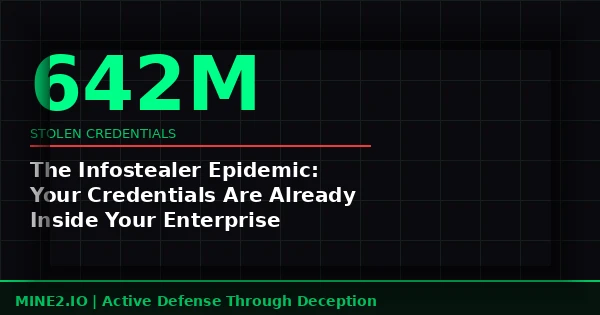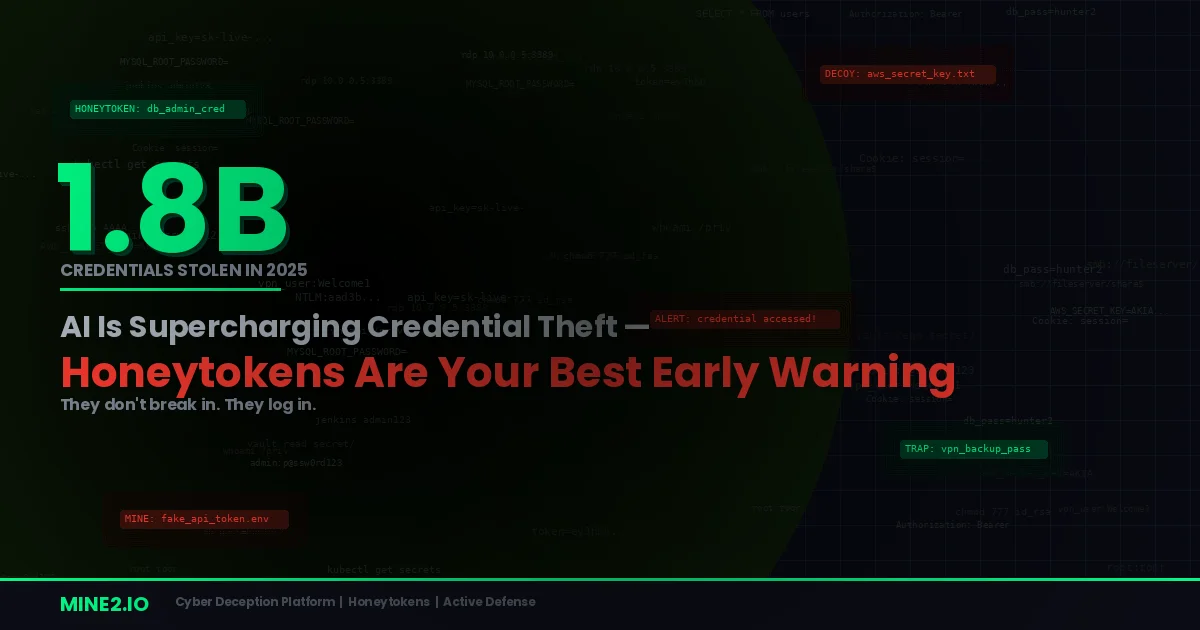
In 2025, infostealers harvested 1.8 billion credentials from 5.8 million compromised endpoints. That's not a typo. According to Flashpoint's Global Threat Intelligence Index, credential-based attacks surged 160% year-over-year, which makes stolen identities the most reliable weapon in the modern attacker's kit. Verizon's 2025 DBIR backs it up: 22% of all breaches now start with compromised credentials, overtaking phishing as the dominant initial access vector.
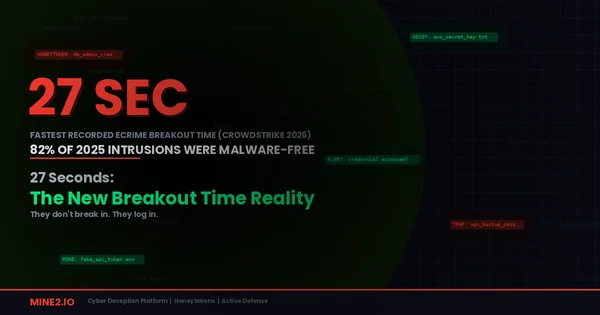
The CrowdStrike 2026 Global Threat Report sharpens the point. AI-enabled adversary operations jumped 89% year-over-year, and the average eCrime breakout time collapsed to 29 minutes. The fastest observed breakout? Twenty-seven seconds from initial access to lateral movement.
I track threat actors for a living, and I can tell you this is today's reality, not tomorrow's problem. The traditional stack is losing the race.
The Identity Crisis: How Credentials Became the #1 Attack Vector
The move from exploit-driven breaches to identity-led intrusions built up over years, but 2025 was the tipping point. Darktrace's Annual Threat Report 2026 found that identity weaknesses played a material role in nearly 90% of incident response investigations. Unit 42's Global Incident Response Report 2026 said the same: initial access came through identity-based techniques, phishing, stolen credentials, brute force, and insider activity, in 65% of cases.
What changed? Three things converged.
AI-powered infostealers hit industrial scale. Malware families like Lumma, Redline, StealC, and Acreed now ship through Malware-as-a-Service platforms, so low-skill attackers can run credential-harvesting campaigns with almost no effort. Specops analyzed over 6 billion stolen passwords pulled from infostealer campaigns during 2025 alone. IBM's X-Force reported more than 300,000 ChatGPT credentials exposed through infostealers, a signal that AI platforms now carry the same credential risk as enterprise SaaS.
Phishing got frighteningly good. AI-crafted phishing messages are personalized, long-form, and almost indistinguishable from real communication. Darktrace observed a 28% increase in QR-code-based phishing (1.2 million attacks), and novel social engineering techniques grew from 32% to 38% of observed campaigns. More than 8.2 million phishing emails specifically targeted VIP accounts, the executives and privileged users whose credentials unlock the widest access.
Attackers don't need exploits anymore. Why burn a zero-day when you can just log in? eSentire's 2025 Year in Review documented a 389% rise in account compromise, with credential access representing 75% of all malicious activity observed. The Check Point finding is stark: leaked credentials rose 160% year-over-year, and most compromised accounts were personal, not corporate, often thanks to password reuse across services.
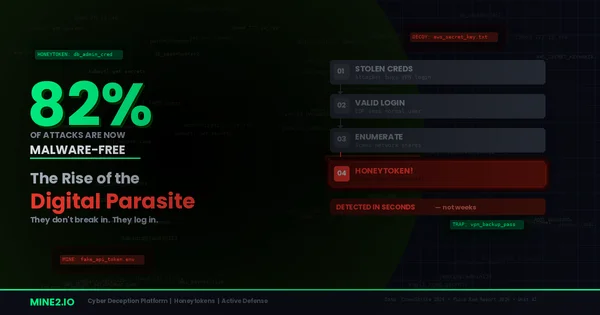
The result? Once they're in, attackers use legitimate tools and permissions to disappear into normal activity. Lateral movement is fast, quiet, and nearly invisible to traditional detection. I walked through that broader shift in why 82% of attacks are now malware-free.
Why EDR, SIEM, and MFA Aren't Enough
Here's the uncomfortable truth: your existing security stack was designed for a different era.
EDR watches endpoints, not identities. When an attacker logs in with a valid credential, the endpoint sees a legitimate session. No malware to detect, no exploit signature to match. The CrowdStrike report documents adversaries using AI-generated scripts to speed up credential dumping while wiping forensic evidence, all within the time it takes your SOC to triage one alert.
SIEM drowns in noise. With the industry facing a 4.8 million worker shortage, SOC teams already live in alert fatigue. When the attacker's activity looks identical to normal user behavior, SIEM rules don't fire. By the time anomaly detection correlates enough signals, exfiltration may already be done. Unit 42 observed the fastest quarter of intrusions reaching exfiltration in just 72 minutes in 2025, down from 285 minutes in 2024.
MFA is being bypassed at scale. Phishing-as-a-Service kits like Tycoon2FA, FlowerStorm, and EvilProxy are purpose-built to intercept MFA tokens in real time. eSentire found these PhaaS kits to be comprehensive, continuously updated offerings designed to defeat modern MFA. Session hijacking through stolen authentication cookies makes MFA meaningless after the first login. The OAuth angle is its own rabbit hole; I'd point you to device-code phishing and OAuth token theft for that.
The deeper problem? These tools are reactive. They detect attacks after something bad already happens on a real system. The damage window, the gap between initial access and detection, is where breaches metastasize.
The Deception Advantage: What Honeytokens Catch That Nothing Else Does
Cyber deception flips the detection model. Instead of waiting for malicious behavior on production assets, you plant decoy credentials, documents, and services across your environment. Any interaction with those decoys is, by definition, unauthorized, which generates an immediate, high-fidelity alert with zero false positives.
Here's why deception works so well against the credential theft epidemic.
Honeytokens Catch Credential Harvesters in the Act
When an infostealer scrapes a compromised endpoint, it can't tell real from fake. Mine2 honeytokens, fake AWS keys in environment variables, bogus database connection strings in config files, decoy API tokens in code repositories, get swept up alongside the legitimate secrets. The moment an attacker tries to use a honeytoken, the alert fires. No behavioral analysis. No anomaly scoring. No waiting for correlation.
This is especially potent against the infostealer supply chain. Credentials stolen by Lumma or Redline land on dark web markets, where other threat actors buy them. When those buyers try a honeytoken harvested months earlier, the deception still works, which gives you a persistent, long-lived early warning system. The infostealer epidemic and MFA bypass breakdown goes deeper on that resale economy.
Decoy Services Expose Lateral Movement Instantly
Once attackers are inside with valid credentials, the next move is reconnaissance, scanning for accessible services, open ports, and exploitable targets. Mine2's MineField deploys decoy TCP services that look and respond like real production systems. Any connection attempt is an instant indicator of compromise, catching the lateral movement that EDR and network monitoring would file under normal internal traffic. Service accounts make this worse, which is exactly what service-account lateral movement covers.
Cloud Mines Detect Cloud Credential Abuse
With 94% of organizations relying on cloud infrastructure, and Azure alone attracting 43.5% of observed malware samples (per Darktrace), cloud credential theft is an acute risk. Mine2's Cloud Mines scatter fake AWS resources, decoy S3 buckets, phantom IAM roles, bogus Lambda functions, across your cloud environment. When compromised cloud credentials get used to enumerate resources, Cloud Mines trigger before any real asset is touched.
Zero False Positives, the SOC's Best Friend
The deception technology market is projected to grow from $2.21 billion in 2024 to $5.61 billion by 2032 (Verified Market Research), and the zero-false-positive advantage is a big reason why. When SOC teams are drowning in alerts and the talent gap keeps widening, a detection mechanism that only fires on genuine malicious activity changes everything. Every honeytoken alert is actionable. Every decoy interaction demands investigation.
Practical Playbook: Deploying Honeytokens Against Credential Theft
Here's how to start building a deception layer into your credential defense.
1. Seed Honeytokens Where Infostealers Harvest
Plant fake credentials where attackers and their malware look first: browser credential stores, environment variables, .env files, AWS credentials files (~/.aws/credentials), SSH key directories, and config files. Those are the exact locations infostealers scrape, which makes them ideal honeytoken placement points.
2. Deploy Decoy Credentials in Active Directory
Create honeytoken accounts in Active Directory with enticing names, svc_backup_admin, sql_replication, legacy_vpn, that read like high-value service accounts. When an attacker harvesting credentials via Mimikatz or DCSync tries to use them, you get an immediate alert and a strong signal of AD compromise.
3. Scatter Fake Secrets in Code Repositories
Embed honeytoken API keys and database connection strings in internal Git repositories, CI/CD pipeline configs, and documentation wikis. This catches external attackers who've gained repo access and insiders running unauthorized reconnaissance alike.
4. Deploy MineField Across Network Segments
Place decoy services on unused IP addresses and ports across your network segments. This builds a tripwire for any port scanning or lateral movement, catching behavior that would otherwise blend into normal traffic.
5. Extend Deception into Cloud Environments
Use Mine2's Cloud Mines to generate fake resources across your AWS footprint. Attackers who gain cloud credentials will naturally enumerate available resources, and the first decoy they hit becomes your earliest warning.
6. Wire Deception Alerts into Your SOC Workflow
Integrate honeytoken alerts with your existing SIEM and SOAR platforms to trigger automated response: isolate compromised endpoints, revoke credentials, and kick off incident response before the attacker reaches real assets.
The Bottom Line
The credential theft epidemic is accelerating. AI is making attackers faster, stealthier, and more capable than ever. Traditional defenses, EDR, SIEM, MFA, stay necessary but insufficient against identity-led intrusions where attackers log in rather than break in.
Cyber deception, and honeytokens specifically, close the fundamental gap. They detect credential abuse at the moment of use, with zero false positives and no dependence on behavioral baselines. In a landscape where breakout times are measured in seconds and stolen credentials number in the billions, that kind of early warning isn't optional. It's essential.
The organizations that survive the AI-accelerated era won't be the ones with the biggest security budgets. They'll be the ones who made the attacker's stolen intelligence unreliable, turning every credential cache, every network scan, and every cloud enumeration into a potential tripwire.
Ready to turn your credential landscape into a minefield for attackers? See how Mine2's honeytokens work →
Riya
Principal Threat Researcher, Mine2 Labs
Riya tracks active threat campaigns and APT tradecraft at Mine2 Labs, translating real-world attacker behaviour into practical detection ideas.
Recent Articles
Need Security Help?
Protect your organization with MINE2's cyber deception platform.