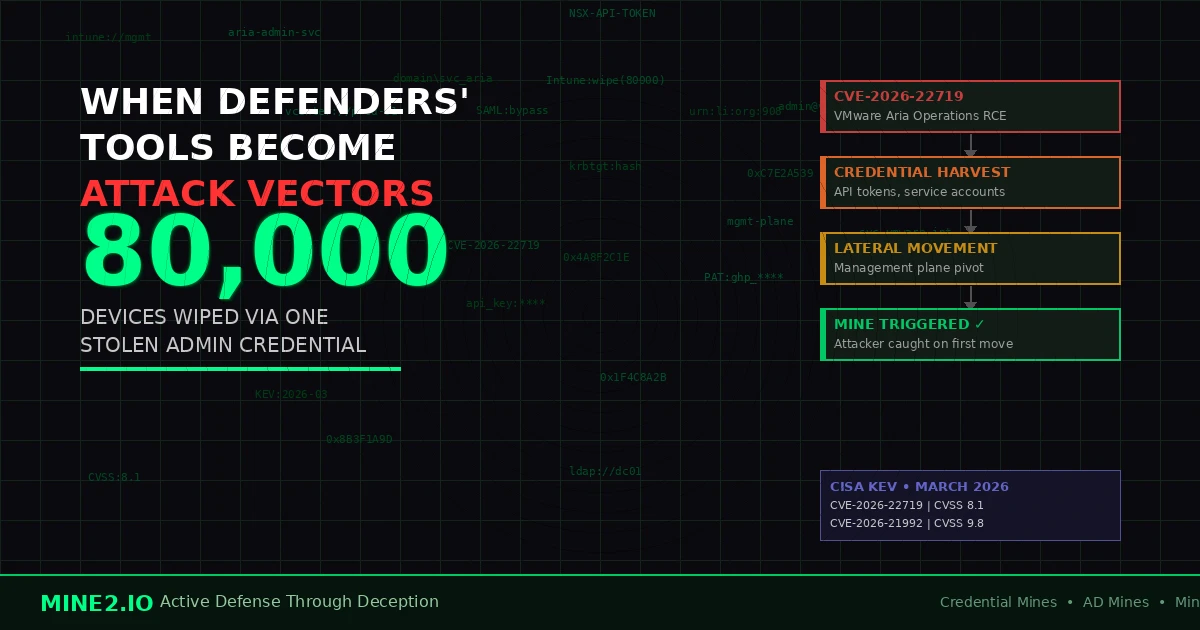
There's a brutal irony at the heart of enterprise security in 2026: the platforms your team relies on to detect, manage, and respond to threats have become the highest-value targets for attackers. When CISA added CVE-2026-22719 — a command injection flaw in VMware Aria Operations — to its Known Exploited Vulnerabilities catalog on March 3, 2026, it surprised no one in threat intelligence. It confirmed a trend two years in the making: attackers have systematically shifted their attention from endpoints to the administrative platforms that govern them all.
VMware Aria Operations is not a peripheral tool. It's the observability and management backbone for tens of thousands of enterprise VMware environments. Compromise it and you gain visibility into every workload, every configuration, and every credential stored within. The CVSS score for CVE-2026-22719 is 8.1, but the operational blast radius of exploitation is orders of magnitude higher. Federal civilian agencies were given until March 24, 2026 to apply fixes — a timeline that tells you everything about the urgency CISA assigns to this class of flaw.
I build detection logic for a living, and the part that frustrates me most about this trend is how cleanly it sidesteps the detections most teams have invested in. This post walks through why management platforms have become the primary beachhead in advanced attacks, why your existing controls struggle to detect the post-exploitation phase, and how deception — specifically Credential Mines and AD Mines — closes the gap every other tool leaves open.
The Management Platform Is the New Crown Jewel
Attackers follow value. For years that meant targeting endpoint devices, then moving laterally to find sensitive data. The calculus changed when enterprises poured money into endpoint detection and response. Today, a compromised laptop generates dozens of alerts within minutes. A compromised VMware Aria administrator account? That can go undetected for weeks.
The Stryker attack in March 2026 is the definitive case study. An Iran-aligned hacktivist group obtained a single compromised Microsoft Intune administrator account and, from that one foothold, remotely wiped approximately 80,000 devices across Stryker's global network — simultaneously, in real time. Employees watched their computers erase themselves. The attack didn't need malware deployed to endpoints. It didn't need lateral movement through workstations. It needed one set of management credentials and the knowledge to turn the platform's own APIs against the organization that built it. We unpacked the destructive mechanics of that incident in our breakdown of the Stryker wiper attack and deception.
Here's the attacker's insight: management platforms are designed for scale. They can push policy to 80,000 devices as easily as to one. When an attacker gets management credentials, they inherit that scale. Traditional endpoint security is irrelevant — the destruction runs through legitimate platform functionality.
The pattern goes beyond Intune. In the same month, Oracle released patches for CVE-2026-21992 in Identity Manager — a critical flaw with a CVSS score of 9.8 enabling unauthenticated remote code execution against the identity and access management platform that governs who can authenticate to everything else in the enterprise. When your identity management system is the breach, no authentication event is trustworthy. Active Directory, LDAP, SAML federation — all compromised at the source.
Why This Pattern Keeps Accelerating
Three structural forces are converging to make management platform exploitation the dominant attack vector of 2026.
First, security teams have successfully hardened the endpoint perimeter. Investment in EDR, privileged access workstations, and credential hygiene at the workstation level has raised the cost of traditional lateral movement. Attackers responded rationally and went for the management layer instead.
Second, management platforms have accumulated extraordinary privilege as enterprises consolidated tooling. Aria Operations manages infrastructure. Intune manages endpoints. Oracle Identity Manager manages authentication. Centralization improves operational efficiency and creates a catastrophic single point of compromise. The Datadog DevSecOps 2026 Report found that 57% of organizations reported experiencing a security incident based on exposed secrets from insecure management and DevOps processes in the prior two years.
Third, these platforms are hard to monitor from the outside. You can't drop a third-party agent onto Aria Operations. You can't instrument every API call within Intune without performance implications. The platforms supposed to be watching everything get the least scrutiny applied to their own activity.
What the Attack Chain Actually Looks Like
The typical management platform compromise in 2026 follows a predictable sequence — and that predictability is exactly why detection is hard.
Initial access arrives via one of three pathways: exploitation of an unpatched vulnerability (CVE-2026-22719 being the most recent example), theft of a service account credential from a CI/CD pipeline or secrets manager, or phishing a platform administrator whose multi-factor authentication was bypassable via session token hijacking. CISA's analysis of the SharePoint RCE vulnerability CVE-2026-20963 — also added to the KEV catalog in March 2026 — shows a parallel pattern where productivity platforms with deep Active Directory integration become access pathways to identity systems.
Once inside the management platform, the attacker's first move is consistent: credential harvesting. Aria Operations stores API tokens, vCenter service account credentials, NSX integration certificates, and SMTP relay credentials. Identity Manager stores every service account, privileged user, and application integration secret in the environment. The goal is to harvest these silently — not to deploy ransomware right away, but to build a complete map of the privilege estate before making any visible move.
The second phase is persistence. Using the platform's own native capabilities, attackers create backdoor accounts, modify monitoring rules to exclude their activity, and set up scheduled tasks that survive a password reset of the initially compromised account. The Stryker attack demonstrated a third-phase execution where destruction was the goal; in financially motivated attacks, this phase is usually lateral movement to financial systems or data repositories.
The critical detection window is the credential harvesting phase. Attackers are reaching into stored credentials, trying to authenticate with them against other systems, and probing the credential store for more accounts. This is exactly where deception turns the attacker's own methodology against them.
Why Traditional Controls Fail at the Management Layer
Every enterprise security architecture assumes a trust boundary: the tools doing the monitoring are trusted, the systems being monitored are not. Management platform exploitation breaks that assumption completely.
Your SIEM ingests logs from Aria Operations. When an attacker uses an Aria administrator account, the activity looks legitimate — the SIEM has no baseline for what "abnormal" Aria administrator behavior looks like, because administrator behavior is inherently variable. Your PAM solution may wrap access to Aria itself, but once inside, the attacker can generate API tokens that bypass PAM entirely. Your EDR can't see activity that happens within the management plane rather than on endpoints. It's the same blind spot we documented when EDR killers leave deception standing — once the trusted control plane is the attacker's home turf, the agent that's supposed to watch it is no longer watching.
The deeper issue is signal quality. CISA's investigation into CVE-2026-22719 exploitation found that in the majority of confirmed incidents, the attack had been underway for 14 to 21 days before detection. In every case, the platform's own logs contained indicators — anomalous API calls, unusual credential access patterns, authentication from unexpected source IPs — but the sheer volume of legitimate management activity buried the signal. Security operations teams reviewing hundreds of events per hour can't reliably surface the one pattern that indicates credential harvesting inside a management console.
This isn't a resourcing problem. It's a fundamental signal-to-noise problem that more analysts and more SIEM rules won't solve. You need a control that produces an unambiguous, zero-false-positive alert the moment an attacker touches it.
How Credential Mines and AD Mines Break the Chain
Mine2's deception applies a simple but powerful principle to the management platform problem: plant credentials that look real but have never been used for anything legitimate, then watch them for any access. The first access to a mine is always an attacker, because no legitimate process ever touches it.
Credential Mines planted within VMware Aria Operations take the form of stored API tokens, vCenter service account entries, and integration credentials that appear to belong to real systems but route to mine detection infrastructure. When an attacker harvests credentials from Aria and tries to use them — to authenticate to vCenter, call an AWS API, or connect to a database — the mine fires a high-fidelity alert. Not a suspicion. Not a risk score. A confirmed breach event, timestamped to the minute of first use.
AD Mines address the identity management vector directly. When an attacker compromises Oracle Identity Manager or extracts credentials from Active Directory via a management platform integration, they hunt for privileged accounts to impersonate: service accounts with domain admin rights, application integration accounts with broad read access, administrator accounts tied to security tooling. AD Mines are built to look exactly like these. They have realistic naming conventions, appropriate group memberships, and last-login timestamps that establish credibility. Any attempt to authenticate as a mine account — via Kerberos, LDAP, NTLM, or SAML — generates an immediate alert with full attribution: source IP, timestamp, authentication method, and lateral movement destination.
MineField decoy services cover the network discovery phase. Before an attacker uses harvested credentials, they typically probe the network to understand the topology — which management consoles are reachable, what APIs respond on which ports, where RDP is available on management workstations. MineField plants decoy TCP services on ports and addresses that no legitimate system should ever scan. The first probe is the alert.
What I appreciate about this from a detection-engineering standpoint is that it needs no tuning, no baseline establishment, and no alert fatigue management. A mine either triggers or it doesn't. When it triggers, the event isn't a hypothesis — it's a confirmed breach that immediately kicks off the incident response workflow.
When the Management Platform Is Breached, the Reporting Clock Starts
Management platform compromises create immediate and severe compliance exposure because of what these platforms can reach. A breach of Aria Operations or Oracle Identity Manager isn't a breach of one system — it's a potential breach of every system those platforms manage, authenticate, or store credentials for.
GDPR Articles 33 and 34 require notification to supervisory authorities within 72 hours of becoming aware of a personal data breach, and notification to affected individuals when the breach is likely to result in high risk. When a management platform is compromised, the scope of potentially affected personal data — stored in managed systems, accessible via managed credentials — is vast, and the 72-hour clock begins at awareness. Mine2's detection evidence provides the precise timestamp of first attacker activity, which is critical for demonstrating awareness timelines to regulators.
India's Digital Personal Data Protection Act (DPDP Act) requires data fiduciaries to notify the Data Protection Board and affected data principals "without delay" upon becoming aware of a personal data breach. Management platform compromises in environments processing Indian citizen data trigger these obligations immediately. Mine2's mine triggers provide the timestamped evidence of breach discovery the DPDP process requires.
PCI-DSS Requirement 11 mandates testing of security controls and monitoring of all access to network resources and cardholder data. Management platform credentials with access to payment processing infrastructure create direct PCI scope implications. The audit trail generated by Mine2 mine triggers provides the evidence of detection capability Requirement 11 audits require.
CERT-In's 6-hour reporting mandate — arguably the most aggressive breach reporting requirement globally — requires Indian organizations to report any breach within six hours of discovery. Mine2's real-time alerting ensures discovery happens at the moment of first attacker activity, not weeks later during a forensic investigation. The difference between detecting a breach in six minutes via a mine trigger and detecting it in 14 days via log analysis is the difference between compliance and a reportable violation.
SEBI and RBI directives for regulated financial entities in India require robust controls over privileged access and management infrastructure. Mine2's mine deployment within management platforms provides the evidence of active deception-based monitoring that these frameworks increasingly recognize as a best-practice detection control.
HIPAA requires covered entities and business associates to implement technical safeguards that control access to electronic protected health information and to audit activity in systems containing ePHI. Management platforms with access to healthcare IT environments fall within scope, and mine triggers provide the access monitoring evidence the Security Rule requires.
A Practical Playbook for Protecting Your Management Stack
Organizations looking to close the management platform detection gap should work a deception-forward strategy.
The first priority is inventory. Map every management platform in the environment — VMware Aria Operations, Microsoft Intune, ServiceNow, Splunk infrastructure, identity management systems, PAM consoles — and identify what credentials each platform stores or can generate. This inventory defines your mine placement strategy.
The second step is mine deployment within each platform. In Aria Operations, plant Credential Mines that look like vCenter integration accounts and NSX service tokens. In Active Directory and identity management systems, deploy AD Mines that look like platform service accounts. In PAM vaults, create mine accounts that appear to be high-privilege emergency access credentials. Mine2's single-click deployment means this step takes minutes, not weeks.
The third step is the detection-to-response workflow. When a mine triggers, the response should be immediate: isolate the management platform session, rotate all credentials stored within the platform, kick off forensic collection from the platform's activity logs for the window preceding the trigger, and begin scope assessment of which managed systems may have been accessed. The mine trigger tells you an attacker has credentials — the forensic investigation tells you what else they took.
The fourth step is a regular mine rotation schedule. Credential mines should be refreshed periodically so their appearance stays credible. Mine2's automated rotation handles this without operational overhead.
The Detection Gap Is Not Acceptable
The March 2026 disclosures — CVE-2026-22719 in VMware Aria Operations, CVE-2026-21992 in Oracle Identity Manager, the ongoing exploitation of SharePoint and other management platform vulnerabilities — represent a trend that won't reverse. Attackers have learned that management platforms are the leverage point for maximum impact at minimum cost. One compromised Intune administrator account cost Stryker the wipe of 80,000 devices. One compromised Aria Operations instance yields the credential estate for an entire VMware environment.
The organizations that detected these compromises early — before destructive execution, before mass exfiltration — were the ones with controls that generated unambiguous signals the moment stolen credentials were first used. Detection through tuned SIEM rules, behavioral analytics, or log review is fundamentally too slow for this threat. By the time anomaly-based detection fires, the attacker has had days or weeks of dwell time.
Credential Mines and AD Mines deployed within management platforms work differently. They don't analyze behavior patterns. They don't require baseline establishment. They generate a single, high-fidelity alert the first time an attacker touches them — which, in the management platform context, is the moment stolen credentials are used for lateral movement. That's the earliest possible detection point, and it's the one that matters.
Closing Thoughts
The weaponization of management platforms is not a temporary attacker preference. It's a structural response to improved endpoint security, and it will intensify as enterprises keep consolidating administrative tooling. CVE-2026-22719 is not the last critical management platform vulnerability CISA will add to the KEV catalog this year. The Stryker incident is not the last time a management credential gets used to destroy infrastructure at scale.
The question for security teams isn't whether management platforms will be targeted, but whether they'll have the controls in place to detect the breach before the attacker executes. Deception technology — Credential Mines planted in the management layer and AD Mines mimicking privileged service accounts — provides the answer: immediate, zero-false-positive detection at the moment of first credential use.
Ready to close the management platform detection gap? See how Mine2 deploys Credential Mines and AD Mines across your management infrastructure in a single click: https://www.mine2.io/product
Arjun
Lead Detection Engineer, Mine2
Arjun builds detection logic at Mine2, focusing on the blind spots EDR and SIEM leave behind and how honeytokens close them.
Recent Articles
React2Shell CVE-2025-55182: 766 Next.js Hosts Breached in Automated Credential-Theft Wave
Kerberoasting in April 2026: Why CVE-2026-20833 Enforcement Is Not Enough Without AD Mines
The Service Account Blind Spot: How FortiGate Intrusions Expose the Lateral Movement Crisis
Need Security Help?
Protect your organization with MINE2's cyber deception platform.