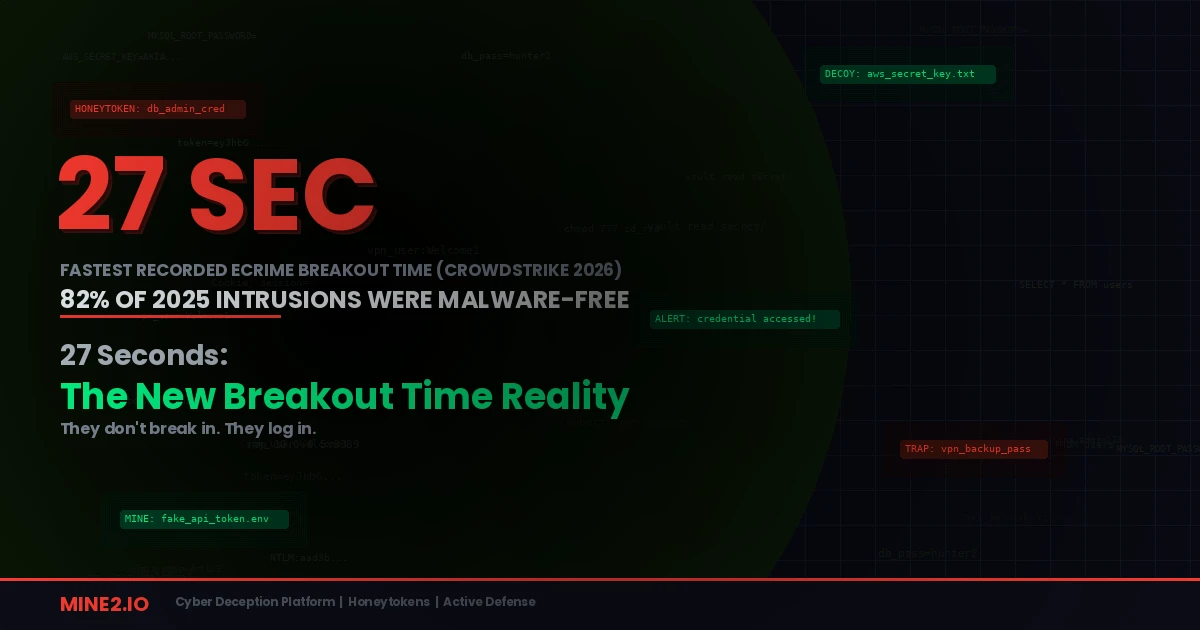
Twenty-seven seconds.
That's the fastest lateral-movement breakout CrowdStrike logged anywhere in 2025 — the gap between an attacker's first foothold and their first hop to a second machine. Not the average. The record. I've spent enough years staring at SIEM dashboards to know what that number does to a detection roadmap: it makes most of it obsolete on arrival.
The number that should worry you more than the average
CrowdStrike's 2026 Global Threat Report put the average eCrime breakout time at 29 minutes in 2025 — down from 48 minutes in 2024, and 98 minutes back in 2021. That's a 65% jump in speed year-over-year, and a 70% collapse over five years. In one intrusion the report documents, data exfiltration started within four minutes of initial access. Four minutes to get in, look around, and start pulling data out the door.
I want to sit on the 27-second figure for a moment, because averages hide the part that actually matters operationally. An average of 29 minutes tells you what to expect on a typical Tuesday. It says nothing about your worst day. The 27-second breakout tells you what your worst day looks like, and it looks like this: SOC analyst gets paged, opens the ticket, checks Slack, pulls up the dashboard — and the attacker is already three systems deeper than where they started. You were never in that fight. The fight was over before your pager buzzed.
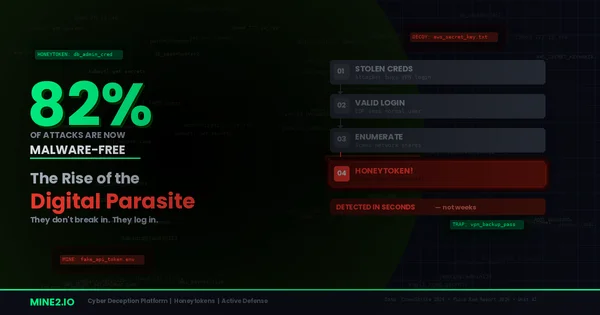
Here's the harder pill: 82% of the detections CrowdStrike logged in 2025 were malware-free. Up from 51% in 2020. Attackers used stolen credentials, trusted identity flows, and approved SaaS integrations to move — no payload for your EDR to fingerprint, no hash to check against a threat feed, no unusual process tree lighting up an alert. They didn't break in. They authenticated in, using something that looked exactly like you, because it was your credential.
Why "detect faster" isn't a strategy, it's a wish
Most breach-response conversations still center on mean-time-to-detect and mean-time-to-respond, and vendors love selling faster versions of the same idea: better correlation rules, tighter SIEM tuning, quicker analyst triage. All of that helps. None of it changes the fundamental math when the attacker's clock starts at zero and yours starts whenever a human looks at a screen.
You can't out-triage 27 seconds. You can't out-correlate it either — correlation needs at least two data points to correlate, and by the time you have two, the attacker may already be on system three. The only way to compress your response time below the attacker's breakout time is to stop detecting the intrusion after the fact and start triggering on it during the fact — ideally on the very first move they make.
That's a structurally different problem than faster SIEM queries. It's a placement problem. If the earliest possible signal is worth more than any amount of downstream analysis speed, the question becomes: where do you put a sensor that fires the instant — not the minute, the instant — an attacker touches something they shouldn't?
Malware-free means credential-based, and credential-based means bait works
This is where the 82% malware-free figure and the 27-second breakout figure actually connect. If an intrusion has no malicious binary, no unusual process, and no signature to match, what does it have? It has an action: a login, a file read, an API call, a lateral connection — using a credential or token that shouldn't exist, shouldn't be used from that location, or shouldn't be touched at all.
That's exactly the gap honeytokens are built to close. A fake AWS key sitting in a config file that's never legitimately read produces zero false positives and zero noise — until the moment someone reads it, at which point it produces one alert with 100% fidelity, because there is no legitimate reason for that read to exist. A decoy AD service account with a slightly-too-interesting name, planted where a post-compromise net user sweep would find it, doesn't wait for a SIEM correlation rule to connect five events across three log sources. It fires the moment it's touched. That's a detection window measured in seconds, sitting directly inside the attacker's own breakout window instead of chasing it from behind.
We built Mine2's deception layer around this exact premise: place tripwires at the places a malware-free, identity-driven attacker is statistically certain to touch during recon and lateral movement — fake credentials in Active Directory, decoy cloud resources, bogus API keys — and let the interaction itself be the alert. No behavioral baseline to tune. No malware signature to miss. Just: something touched a thing that should never be touched, tell someone now.
This isn't a theoretical placement strategy either. In a recent engagement, Mine2's honeytokens caught an insider mid-exfiltration at an IT services firm — same underlying principle as an external credential thief, same reason signature-based tools stayed silent: nothing malicious ever touched disk. The access itself, at the wrong asset, was the tell.
Where deception sits relative to the 29-minute clock
Walk the CrowdStrike timeline against a honeytoken deployment and the placement becomes obvious:
- Initial access (T+0): Attacker lands via a phished or infostealer-harvested credential. Nothing to catch here — the login is "valid."
- Recon (T+1 to T+5 min): Attacker enumerates shares, service accounts, cloud roles, saved credentials. This is where a decoy credential file, a fake
.aws/credentials, or a canary AD account gets touched. If it's planted correctly, this is your first — and possibly only — alert, and it lands inside the attacker's first five minutes, not your SOC's next shift. - Lateral movement (T+5 to T+29 min): Real breakout happens here on average, T+27 seconds in the worst case. If recon-stage deception didn't fire, a decoy service listening on a port that has no legitimate traffic reason to exist can still catch the pivot itself.
- Exfiltration (T+4 min in the worst documented case): By this point you want to already know. Deception that only fires here is deception that fired too late.
The point isn't that honeytokens replace EDR or identity monitoring — CrowdStrike's own recommendations (phishing-resistant MFA, least-privilege access, cross-domain telemetry) are still table stakes. The point is that none of those controls produce a same-second, zero-ambiguity signal the way a triggered decoy does, and in a world where the record breakout is 27 seconds, same-second is the only speed that matters.
The AI acceleration makes this worse, not better
CrowdStrike also logged an 89% year-over-year jump in attacks by AI-enabled adversaries, and it's worth being precise about what that acceleration touches. AI isn't inventing new attack classes yet — it's compressing the time between "adversary decides to act" and "adversary has acted," across recon, phishing content generation, and post-exploitation scripting. Compress the human-driven parts of an intrusion and the 29-minute average has nowhere to go but down. If you're building a 2026-2027 detection roadmap around today's breakout numbers, you're already building for last year's threat.
We've written before about how infostealer-driven credential theft routes around MFA entirely, and how Kerberoasting-style AD abuse gives attackers exactly the kind of "valid" access that produces zero malware signatures. Both are variations on the same theme this report confirms at scale: the credential is the payload now, and payload-based detection was never going to be enough on its own.
There's a broader pattern here too: the shift from malware-based to identity-based intrusion isn't new for 2025, it's an acceleration of a trend Mine2 flagged as far back as our piece on service-account lateral movement, where the attacker never needed a single malicious file to move from a compromised service account to domain-wide access. What's changed since then is the clock. The technique is the same; the window to catch it has shrunk from hours to a number that now starts with "27."
What to actually do with this
If you take one thing from the 2026 report, don't let it be "attackers are faster" — everyone already knows that. Take this instead: your detection strategy has to include at least one control category where the alert fires on interaction, not on analysis. Log review, SIEM correlation, and EDR behavioral scoring are all analysis-after-the-fact, and analysis-after-the-fact cannot beat a 27-second clock no matter how well it's tuned.
Deception can. A honeytoken doesn't need to be smarter than the attacker or faster at correlating events — it just needs to be in the room when they arrive, wearing something that looks worth stealing. That's a much lower bar to clear than "detect a credential-based intrusion faster than 27 seconds using log analysis," and it's the bar Mine2 is built around.
See how Mine2 deploys deception across identity, cloud, and network layers to catch malware-free intrusions at the moment of contact — not the moment someone finally reads the alert.
Arjun
Lead Detection Engineer, Mine2
Arjun builds detection logic at Mine2, focusing on the blind spots EDR and SIEM leave behind and how honeytokens close them.
Recent Articles
Need Security Help?
Protect your organization with MINE2's cyber deception platform.