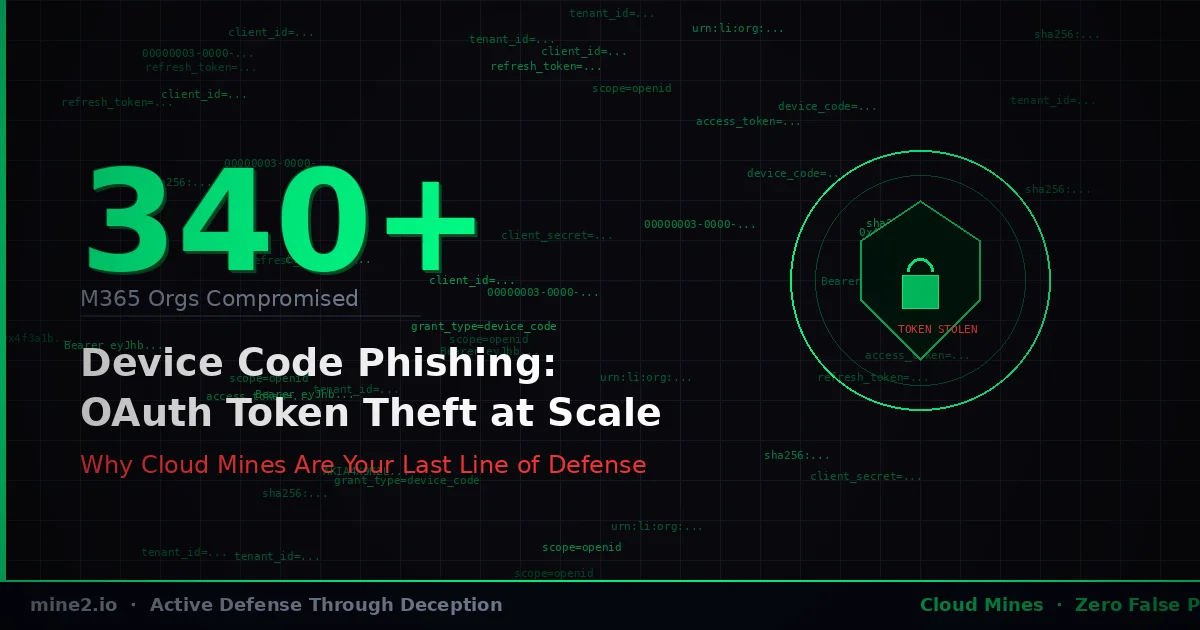
Read this number carefully if you run Microsoft 365: 340. That's the count of organisations confirmed compromised by a single, ongoing device code phishing campaign tracked by Microsoft Threat Intelligence since February 2026 — across five countries, spanning financial services, healthcare, legal, and government. The attackers stole something more valuable than passwords. They stole OAuth access tokens: persistent, MFA-bypassing, cryptographically valid keys to your entire Microsoft cloud estate.
Traditional security tools didn't catch it. The email security gateway didn't catch it. The endpoint detection and response platform didn't catch it. The identity and access management alerts didn't catch it. For many of these 340 organisations, the first sign of the breach was the attacker already inside SharePoint, reading email from Exchange Online, and pulling files out of OneDrive — using a completely legitimate Microsoft authentication token.
I've chased token abuse across cloud tenants for years, and this is the shape of identity-based compromise in 2026.
How Device Code Phishing Works, and Why It Lands
The OAuth 2.0 device code flow was built for a legitimate purpose: authenticating on devices that have no browser, like smart TVs, printers, and IoT terminals. The flow works like this — the device requests a short-lived user code from the identity provider, displays it to the user, and tells them to visit a URL on a separate device to enter the code and authenticate. Once the user authenticates on their phone or laptop, the original device gets a token.
Attackers turned this flow into a devastating phishing primitive. The sequence is deceptively simple:
Step 1 — Lure: The attacker sends a phishing email or Teams message posing as an IT administrator, a Microsoft security notification, or a shared document alert. The message tells the target to visit a legitimate Microsoft URL — microsoft.com/devicelogin — and enter a device code included in the message.
Step 2 — Authentication: The target visits the real Microsoft domain, enters the real device code, and completes their normal authentication — including MFA. Nothing looks suspicious because nothing unusual is happening on the Microsoft side.
Step 3 — Token harvest: The attacker's client, which initiated the device code request, receives a fully authenticated OAuth access token and refresh token. These tokens are persistent — refresh tokens can stay valid for up to 90 days, or indefinitely with continuous use.
Step 4 — Silent access: Using the stolen tokens, the attacker authenticates to Microsoft Graph API, Exchange Online, SharePoint, Teams, and any other Microsoft 365 service. The token is legitimate. The authentication succeeds. No password was stolen. No MFA challenge fires. No anomaly is visible to standard monitoring.
According to Microsoft's Threat Intelligence disclosure in March 2026, the current campaign has targeted organisations in the United States, United Kingdom, Germany, Netherlands, and Australia, focusing on senior executives, finance teams, and IT administrators — the accounts with the highest value tokens.
Why Traditional Controls Can't See This
The device code phishing chain has one property that makes it invisible to most enterprise security stacks: the attacker never touches your environment until they're already inside with a valid token.
Look at what doesn't happen here. There's no malware binary for endpoint detection to flag. There's no malicious URL for your email security gateway to block — the link in the phishing message points to a genuine Microsoft domain. There's no failed login for your identity monitoring to alert on — the user authenticated successfully. There's no suspicious authentication event for Conditional Access to block — the token was issued legitimately by Microsoft.
The CrowdStrike 2026 Global Threat Report found that 82% of detections in 2025 were malware-free, and that the average eCrime breakout time has fallen to just 29 minutes. Device code phishing is a textbook malware-free attack — the same shift we unpacked in the rise of the digital parasite and malware-free intrusions. By the time the attacker has the token and starts their dwell phase, they look identical to a legitimate user.
Unit 42's Global Incident Response Report 2026 documented that identity weaknesses played a material role in almost 90% of incident response investigations — and OAuth token abuse featured prominently. The challenge isn't just preventing token theft. It's detecting what happens after the token is used the first time in your environment. We saw the same MFA-bypass dynamic in the infostealer epidemic driving MFA bypass.
Identity security platforms that look for unusual sign-in locations or impossible travel hit a specific limitation here: the legitimate token generates a legitimate sign-in event from whatever IP the attacker operates from. If that IP is in the same country as the victim, the anomaly score is negligible.
The Post-Compromise Window Is Where Breaches Become Catastrophes
A stolen OAuth token isn't the breach. The breach is what happens during dwell time — the period between initial access and detection. In Microsoft 365 environments, that dwell time can be catastrophic.
With a valid Graph API token, an attacker can enumerate all mailboxes and download email archives silently. They can map your entire Azure Active Directory tenant — users, groups, application registrations, service principals, and their permissions. They can reach SharePoint document libraries and OneDrive vaults. They can read Teams conversations and channel files. They can pivot to any application in your Microsoft 365 estate that trusts the identity provider.
More importantly, they can hunt for additional credentials. Microsoft 365 environments are rich with stored secrets: .env files in SharePoint, configuration files with database connection strings in Teams channels, AWS access keys shared in OneDrive, service account credentials in email threads. A threat actor with persistent OAuth access has weeks to run methodical, low-and-slow reconnaissance — gathering credentials for on-premises Active Directory, cloud environments, third-party SaaS applications, and VPN portals. This is exactly the token-theft-to-lateral-movement chain we traced in the Anodot and Snowflake SaaS integration token theft.
The 2026 CISA and NIST Interagency Report 8597 on protecting tokens and assertions explicitly names OAuth token theft as a priority threat vector for federal agencies — acknowledging that once a valid token is in attacker hands, the window for prevention has closed and only detection and containment can limit damage.
This is exactly where Mine2's Cloud Mines create an asymmetric advantage.
How Cloud Mines Catch OAuth Token Attackers Before They Find Real Secrets
Cloud Mines are fake AWS and Azure resources — S3 buckets, Azure Blob containers, RDS instances, Lambda functions — seeded with realistic-looking but entirely fictitious access credentials and connection strings. These mines sit throughout your Microsoft 365 environment: in SharePoint document libraries alongside real files, in Teams channels, in OneDrive folders, in email signatures, and in Azure Key Vault alongside real secrets.
The principle is simple and effective: a legitimate user navigating your Microsoft 365 environment has no reason to interact with a cloud resource they don't recognise from their own work. A threat actor running post-compromise reconnaissance — systematically reading files, enumerating folders, and harvesting anything that looks like a credential — will hit a Cloud Mine and try to use it.
The moment the fake credential is used to attempt access to the fake cloud resource, Mine2 fires an alert. There's no false positive possible — legitimate users don't touch these resources. The detection is binary: either someone used the credential (attacker) or they didn't (no alert). No thresholds to tune, no anomaly baselines, no machine learning models to train. The same idea underpins non-human identity honeytokens for API keys.
For device code phishing specifically, Cloud Mines close the detection gap at the exact point in the attack where traditional tools go blind. The attacker already has a valid token. They're inside your environment conducting reconnaissance. They're reading files looking for secrets. And they will find your Cloud Mine.
Mine2's Cloud Mines carry zero performance impact on your Microsoft 365 environment and deploy with a single click. You don't need to modify your Azure configuration, install agents on endpoints, or integrate with your tenant beyond placing mine documents in SharePoint and OneDrive. The mines work passively — they wait for the attacker to come to them.
Credential Mines planted in your email environment — fake passwords in IT helpdesk threads, fake VPN credentials in onboarding emails — catch attackers who pivot from Exchange access to credential harvesting. Data Mines in SharePoint libraries alert on document access from unexpected sources. Cloud Mines in Azure Key Vault alert on any attempt to authenticate with fictitious credentials. MineField decoy TCP services detect port scanning if the attacker pivots from cloud access to internal network reconnaissance.
Compliance Obligations When OAuth Token Theft Occurs
Device code phishing and OAuth token theft create significant compliance exposure for organisations in regulated industries. Understanding your notification obligations — and how Mine2's detection accelerates compliance — matters.
GDPR (Articles 33 and 34): Under the General Data Protection Regulation, a personal data breach must be notified to the relevant supervisory authority within 72 hours of the controller becoming aware of it, where feasible. If stolen OAuth tokens are used to access mailboxes containing employee or customer personal data — as they routinely are in Microsoft 365 environments — the breach notification clock starts the moment you become aware. Mine2's Cloud Mine alerts provide a precise, timestamped detection event that establishes when your organisation became aware, which is critical for demonstrating compliance. Without deception-based detection, organisations may not become aware until weeks after initial token theft, creating significant exposure for delayed notification.
India DPDP Act (Digital Personal Data Protection Act): India's DPDP Act, operative from 2024, requires data fiduciaries to notify the Data Protection Board of India and affected data principals of personal data breaches without delay. OAuth token theft affecting Microsoft 365 environments storing Indian resident personal data triggers DPDP notification obligations. Mine2's detection of post-compromise activity in SharePoint and OneDrive — where employee and customer data is typically stored — provides the earliest possible awareness trigger for DPDP compliance.
PCI-DSS (Requirement 11.5): The Payment Card Industry Data Security Standard requires intrusion detection systems to detect and alert on all critical system files, configuration files, and content files. Requirement 11.5 specifically requires change detection mechanisms for critical systems. Cloud Mines functioning as detection tripwires for credential access in cardholder data environments fulfil the spirit of this requirement with zero false positives, providing the audit trail PCI QSA assessors require.
RBI and SEBI Directives: The Reserve Bank of India's cybersecurity framework for banks and SEBI's cybersecurity and cyber resilience framework for market infrastructure institutions both require strong detection capabilities and incident reporting. Mine2's deception technology provides the detection evidence required under these frameworks, with alert logs suitable for regulatory submission.
CERT-In 6-Hour Reporting: India's Computer Emergency Response Team mandatory reporting requirement — notification of cybersecurity incidents within six hours of detection — makes rapid detection existential for Indian organisations. A Mine2 alert triggered within minutes of an attacker's first use of a Cloud Mine credential gives Indian organisations the detection window they need to meet CERT-In's six-hour clock. Without deception-based early warning, the six-hour window may expire before traditional monitoring identifies the intrusion.
HIPAA Security Rule (45 CFR § 164.312): For US healthcare organisations, the HIPAA Security Rule requires technical security measures to guard against unauthorised access to electronic protected health information transmitted over electronic communications networks. Microsoft 365 environments at healthcare organisations routinely hold patient data in email attachments, Teams channels, and SharePoint libraries. Cloud Mines seeded throughout these environments detect unauthorised OAuth token-based access — the exact threat HIPAA's access control and audit control requirements are designed to address.
Practical Playbook: Defending Against Device Code Phishing with Mine2
Organisations facing the current wave of device code phishing should run the following layered response:
Immediate technical controls:
Restrict the device code flow at the Conditional Access policy level for all users who don't have a documented business need for it. Microsoft's Conditional Access policy engine lets you block the urn:ietf:params:oauth:grant-type:device_code grant type for specific user populations. This should be your first action — eliminating the attack surface before addressing detection gaps.
Enable continuous access evaluation (CAE) for your Microsoft 365 tenant. CAE lets Microsoft services revoke tokens in near-real-time when risk signals appear, shrinking the dwell window for stolen tokens.
Audit all existing OAuth application registrations in your Azure AD tenant. Threat actors who gain OAuth access frequently register additional applications with persistent permissions — a technique to keep access even after the original stolen token expires.
Mine2 deployment for detection:
Deploy Cloud Mines across your Azure environment — fake storage account keys, fake service principal credentials, and fake connection strings stored in Azure Key Vault alongside your real secrets. Any attempt to authenticate with these credentials generates an immediate Mine2 alert.
Seed Credential Mines throughout your Microsoft 365 environment. Realistic credential documents in SharePoint libraries, OneDrive folders, and Teams channels create a detection mesh that catches attackers harvesting credentials during their dwell phase.
Configure MineField decoy services on your internal network. Attackers who pivot from cloud OAuth access to on-premises reconnaissance trigger MineField alerts on port scanning, providing lateral movement detection that bridges your cloud and on-premises environments.
Response and investigation:
When a Mine2 alert fires, treat it as a confirmed breach — not a suspicion. The zero false positive guarantee means every Mine2 alert represents real attacker activity. Immediately begin token revocation for all accounts in the blast radius, trigger your incident response playbook, and start your GDPR/DPDP/CERT-In breach notification process with the Mine2 alert timestamp as your awareness event.
Review your Microsoft 365 audit logs for the period between the phishing lure delivery and the Mine2 alert. This timeline defines the reconnaissance scope. Pay particular attention to mailbox access events, SharePoint file access logs, and Azure AD sign-in logs for the compromised account's token.
User awareness — with a critical caveat:
Train users to recognise device code phishing lures. But don't rely on user awareness as your primary control. The current campaign uses sophisticated social engineering that mimics genuine Microsoft security notifications with high fidelity. The 340 compromised organisations weren't staffed with careless employees — they were staffed with normal humans who received convincing messages and followed what looked like legitimate IT instructions. Detection has to work independently of user behaviour.
The Strategic Case for Deception-First Detection
The device code phishing campaign running against Microsoft 365 environments shows a fundamental shift in how enterprise intrusions unfold in 2026. Attackers aren't exploiting software vulnerabilities at scale — they're exploiting the trust architecture of legitimate cloud authentication. They use real Microsoft APIs to steal real authentication tokens issued by real Microsoft identity infrastructure.
In that environment, tools built to detect malware, suspicious binaries, or anomalous network traffic are structurally blind to the initial compromise. They can only detect the downstream consequences — and by then, the attacker has had hours or days inside your most sensitive cloud environment.
Mine2's deception technology is built for this threat model. It doesn't try to identify attacker behaviour by comparing it to baseline legitimate activity. It creates a category of action — touching a mine — that no legitimate user ever performs. The detection is structural, not statistical. It can't be evaded by living off the land. It can't be tuned away by attackers who study your monitoring profile. It fires the moment a mine is touched, regardless of how legitimate everything else in the attacker's session looks.
With malware-free attacks making up 82% of enterprise intrusions and breakout times falling under 30 minutes, the window between initial access and damage is now shorter than most SIEM alert pipelines. Deception-first detection — mines that alert on first contact — is the only control architecture that operates at the speed this threat landscape demands.
The 341st organisation doesn't have to be yours.
Want to place Cloud Mines and Credential Mines across your Microsoft 365 and Azure environment? Explore Mine2's active defence platform — single-click deployment, zero performance impact, zero false positives.
Neha
Cloud Security Architect, Mine2
Neha works on cloud and identity security at Mine2, covering SaaS, OAuth, and the credential-theft paths attackers favour in the cloud.
Recent Articles
The Infostealer Epidemic: 642 Million Stolen Credentials Are Already Inside Your Enterprise
18,000 Routers, 120 Countries: How APT28's DNS Hijacking Campaign Renders Your M365 Credentials Worthless
React2Shell CVE-2025-55182: 766 Next.js Hosts Breached in Automated Credential-Theft Wave
Need Security Help?
Protect your organization with MINE2's cyber deception platform.