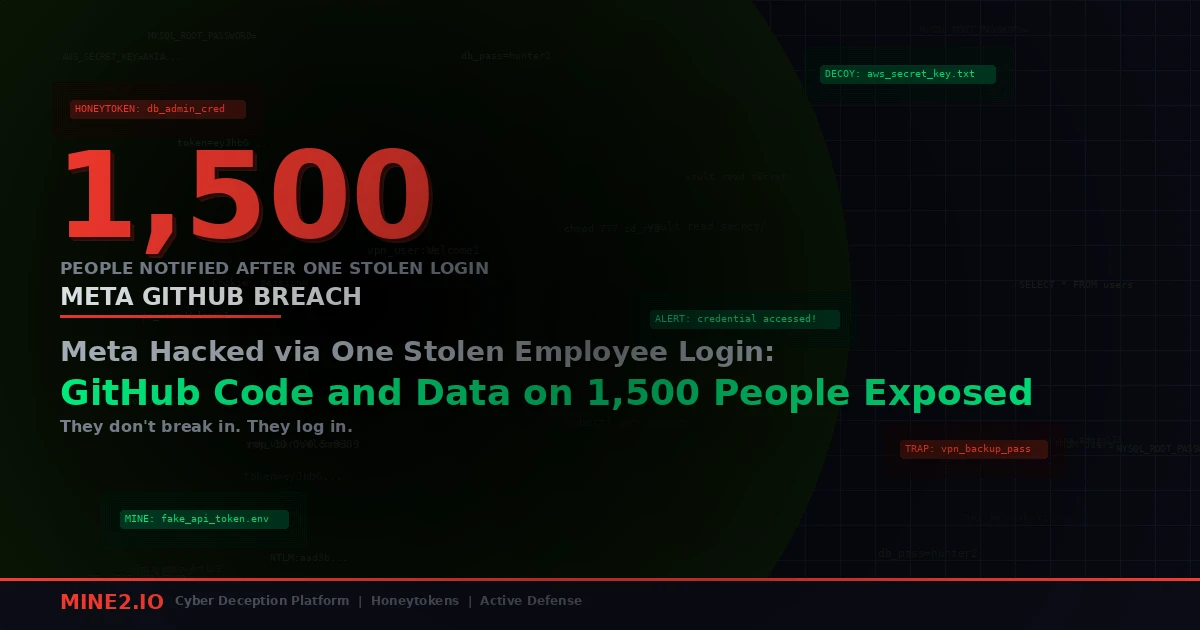
On Tuesday, October 13, Meta started sending breach letters to about 1,500 people. Most of them are its own US employees. The cause, in Meta's words to SecurityWeek: "Meta business data held in a GitHub repository was improperly accessed using an employee's stolen credentials."
No zero-day, no supply-chain implant, no nation-state tooling in the disclosure. Just one login that belonged to someone else.
I've written up enough of these to know that the short version of a disclosure is usually the most honest part. Everything after it is framing. So let's go through what Meta actually said, what it chose to stress, and the one detail I think most readers will skip past.
What Meta has confirmed
Here's the factual core, cross-checked between SecurityWeek's October 13 report and GBHackers' October 14 write-up:
- An outside group got into some of Meta's GitHub repositories using one employee's stolen credentials.
- Meta detected the intrusion "a few weeks ago." That puts discovery somewhere in September, with notifications starting October 13.
- About 99% of what was taken was business data, which Meta describes as software code related to some of its products. The remaining 1% was personal data.
- The personal data should never have been there. Meta says it was added to repositories by mistake, in violation of company policy.
- A "significant portion" of what looks like personal data was synthetic or anonymized test data.
- Meta shut off the access, brought in GitHub and law enforcement, rotated secrets found in the affected repos, and is notifying regulators. Affected people get credit and dark web monitoring.
- Meta's investigation with GitHub so far suggests the attackers weren't specifically targeting Meta's data.
And the line every breached company now includes: "This was not a vulnerability in any Meta product, and Meta's internal systems were not breached."
What the disclosure leaves out
Neither report says how the credential was stolen. Neither names the group. Neither says which products the code belongs to, which kinds of personal data were exposed, or what kind of credential it was. That last gap matters more than people think.
"Stolen credentials" covers a wide range of things. It could be a password plus a phished MFA code. It could be a browser session cookie lifted by an infostealer. It could be a personal access token sitting in a dotfile, or an SSH key on a laptop that got owned. Each one implies a different failure and a different fix. A password reset closes the first. It does almost nothing about the others, a gap we covered in detail when 23.6 million Gyazo records showed why a reset doesn't close a token breach.
I'm not criticizing Meta for withholding this mid-investigation. That's normal. But if you're reading this to calibrate your own risk, don't fill the gap with "they must have been phished." You don't know that, and nobody outside Meta does yet.
"Internal systems were not breached" is doing a lot of work
Technically, a private GitHub organization is a SaaS tenant, not an internal system. Fine. But think about what sits in a large company's private repos in practice:
- Source code, obviously, which tells an attacker how your auth flows, rate limits and abuse controls work.
- CI/CD workflow files that name every secret the pipeline consumes.
- Infrastructure-as-code that maps your cloud accounts, regions and service names.
- Test fixtures, seed data and, as Meta just confirmed, sometimes real personal data that a developer pasted in to reproduce a bug.
- Secrets. Meta rotated "secrets found in the affected repositories." That sentence means there were secrets in the affected repositories.
So "internal systems were not breached" is true. What the attacker got was a detailed description of those internal systems, plus some of the keys to them until rotation finished. In incident response, those are not the same thing, and the second one is often worse.
This is the same pattern we saw with Storm-3168, which found an Azure service principal secret in a GitHub edit history and touched 100 storage accounts in seven minutes. The repo wasn't the target. It was the map.
The detail most people will skip
Meta's investigation suggests the attackers weren't after Meta's data specifically.
Read that again. Someone held a working credential into the private GitHub repos of one of the most heavily defended companies on earth, and the current read is that they weren't hunting Meta. That's what opportunistic credential abuse looks like: a stolen login gets used for whatever it opens, and the attacker sorts out what they got later.
I'll give you my interpretation, and it's an interpretation, not something Meta has said: this reads like a credential that came out of a bulk source, an infostealer log, a combo list, or a broad sweep, and got tested against GitHub because GitHub is where the valuable stuff lives. That fits the year we've had. In the last month alone we covered GhostAction's fake "security audit" workflow hitting 345 repos in two sweeps, driven by hijacked maintainer accounts, and SCARLET LOOP's AI agents testing 12 million stolen logins across 6,171 sites. Credentials get tried everywhere now, automatically, and the attacker doesn't need to know whose door they opened until after it's open.
This lines up with Palo Alto Networks' Unit 42 2026 Global Incident Response Report, which found identity weaknesses played a role in nearly 90% of the incidents its team investigated, and that 65% of initial access involved identity-based techniques like credential theft, MFA manipulation and session hijacking.
Here's why it matters for your defenses. If the attacker isn't targeting you, there's no reconnaissance phase for you to catch. No spear-phishing campaign aimed at your staff, no odd scanning of your perimeter. The first sign of the attacker is the login itself, and it's a valid login. Your SIEM sees an employee authenticating to GitHub and cloning repos. Developers do that every day.
Why "a few weeks" is the number to worry about
Meta caught this. Good. But the timeline in the disclosure is "a few weeks ago," and Meta hasn't said how long access lasted before detection.
When I do post-mortems on repo intrusions, dwell time is almost always the question that decides how bad things are. A clone takes seconds. Once code leaves, you can't pull it back. Secrets are a race: the attacker greps the clone for keys, tests them, and either moves into cloud or doesn't. Every hour between the clone and your rotation is an hour of open access.
What usually tips defenders off in repo incidents isn't the authentication. It's what happens afterwards: an unusual clone volume, an access token used from a new ASN, a cloud API call from an IP that has never touched that account. By the time those fire, the copy has already been made.
So the question isn't "would we catch a stolen GitHub login?" It's "how fast would we know someone is using what they took?"
The accidental lesson in Meta's test data
Here's the part of this disclosure I find most interesting, and I think the security community should pay more attention to it.
Meta said a significant portion of the apparent personal data was synthetic or anonymized test data, and that the attackers may not be able to easily tell real records from fake ones. GBHackers rightly pointed out that this doesn't cancel the real exposure. Agreed. But look at what it means operationally: Meta's repos were full of data that looked valuable and wasn't.
That's what deception is. Meta got it by accident, and only half the benefit. Fake records that look real make an attacker's haul less reliable. But Meta's fake records weren't instrumented, so they couldn't tell Meta anything. Nobody got an alert when someone tried to use them.
Now imagine doing it on purpose. A repository that contains, in a config file or an old commit, an AWS access key that looks exactly like a forgotten production credential. It isn't. It's a honeytoken, a decoy key tied to nothing except an alert. No developer has any reason to use it, because it isn't documented anywhere and doesn't back any real service. So if anyone ever calls AWS with that key, it's an attacker who cloned your repo and is now testing what they found.
That's the property that matters for a case like Meta's. The login was valid, the clone was normal-looking, and the attacker wasn't targeting anyone in particular. None of that changes what the attacker does next: they grep for secrets and test them, because that's the step that turns a code dump into cloud access. A decoy key in the repo catches them at exactly that step, often within minutes of the clone, with no detection rules to tune and no false positives, because there's no legitimate use to confuse it with.
You can apply the same idea elsewhere:
- Decoy cloud credentials in repos, CI variables and infrastructure-as-code, tied to cloud decoy resources that alert on first use.
- Decoy database connection strings pointing at a MineField decoy service that looks like a reachable Postgres or MSSQL host. Anyone who connects is acting on stolen material.
- Seeded fake personal records with unique email addresses or phone numbers. If one turns up in a phishing campaign or a breach dump, you know where the leak started and roughly when.
The last one deserves more attention. Meta's synthetic data muddied the attacker's take. Uniquely tagged synthetic data would also have told Meta which repo leaked, which is exactly what you need when the disclosure question is "whose data was exposed?"
What I'd do this week if I ran a GitHub org
Meta's response list is reasonable: cut access, rotate secrets, keep personal data out of repos, scan for mistakes. Here's what I'd add, roughly in the order I'd do it:
1. Inventory every credential type that can read your org. Passwords plus SSO, classic personal access tokens, fine-grained tokens, SSH keys, deploy keys, GitHub App installations, OAuth apps. Most orgs know about the first one and have no inventory of the rest. If you enforce SSO, check whether old PATs and SSH keys bypass it.
2. Kill long-lived tokens. Classic PATs with no expiry are the worst thing you can have in an org right now. Require expiration, require SSO authorization, and revoke anything nobody claims within a week. The Chilean password spray that hit seven unowned service accounts is what happens when nobody owns a credential.
3. Assume history counts. Scanning HEAD isn't enough. Scan full history for secrets and personal data, then rotate whatever you find even if it was "removed" years ago. A deleted line is still in the clone.
4. Turn on and actually read the audit log. GitHub's org audit log records clones, token creation and repository access. Stream it into your SIEM and alert on bulk clone volume from a single identity, new token creation followed by mass access, and access from unfamiliar IP space.
5. Plant decoys before you need them. Put a few honeytoken credentials in your most sensitive repos, in places an attacker would look and a developer wouldn't: an old .env.example, a legacy deploy script, a commit three years back. It takes minutes, and it's the one control on this list that still works when the attacker has a valid login.
6. Get the personal data out. Meta found real records in repos where policy said there should be none. Every large engineering org has this problem. Run a PII scan across all repos, not just the ones you think are risky.
The question to ask your team
Meta is one of the best-resourced security organizations in the world, and the root cause here was one stolen login. I don't count that against Meta. It tells you where attacks happen now. The company didn't lose because its controls were weak. It lost an employee's credential, the way every company eventually does, and the credential opened what it was meant to open.
So the useful question isn't whether a credential will be stolen at your company. It will. The question is whether you find out when it's used, or weeks later when someone notices the clone logs. If you want to see what it looks like when a stolen key from a cloned repo trips an alert on its first use, book a Mine2 demo and we'll walk you through it on a live decoy.
Kabir
Incident Response Lead, Mine2
Kabir leads incident response work at Mine2, dissecting breaches after the fact to show where earlier detection would have changed the outcome.
Latest Articles
'Engage With Us, or We Will Leak It': The ASOS Breach Arrived Through Its Own App
345 GitHub Repos Hit in Two Sweeps: GhostAction's Fake 'Security Audit' Steals Secrets You Deleted Years Ago
Nearly 20 Million Patients Exposed: Stolen Credentials Unlocked Oracle Health's Unmigrated Cerner Servers
12 Million Stolen Logins Weaponized: SCARLET LOOP's AI Agents Hunted 6,171 Sites That Move Money
Need Security Help?
Protect your organization with MINE2's cyber deception platform.