I've spent a fair part of my career proving that the login page is the softest wall in the building. So when the details of CVE-2026-41940 landed, the part that stopped me wasn't the CVSS 9.8 — plenty of bugs score that high. It was the timeline. Attackers were quietly walking into cPanel & WHM servers as administrators since at least February 23, 2026. cPanel didn't disclose until April 28. That's roughly two months of full admin access on servers running millions of websites, and almost nobody knew.
If you run hosting infrastructure, or your business sits on a shared host that does, this one deserves more than a patch ticket. Here's how the bug actually worked, why your existing tooling probably watched it happen and said nothing, and what a deception layer would have caught on the attacker's very first move.
What CVE-2026-41940 actually did
The flaw lived in the login flow — specifically in how cPanel handled a failed login. On a failed attempt, the application wrote a pre-authentication session file to disk to track the in-progress attempt. Reasonable enough on its own.
The problem was trust. An attacker could smuggle data into an authorization header using CRLF injection — sneaking carriage-return/line-feed sequences that the parser treated as new, legitimate fields. By injecting crafted credentials into that pre-auth session file and then forcing a reload, the attacker convinced cPanel that the session belonged to a fully authenticated administrator. No password. No brute force. No MFA prompt to phish. You ask the door politely, in a dialect it doesn't sanitize, and it opens.
Once in, the blast radius was total:
- Full control of the cPanel/WHM host
- Access to every configuration, database, and hosted site on the box
- On shared servers, compromise of every customer tenant at once
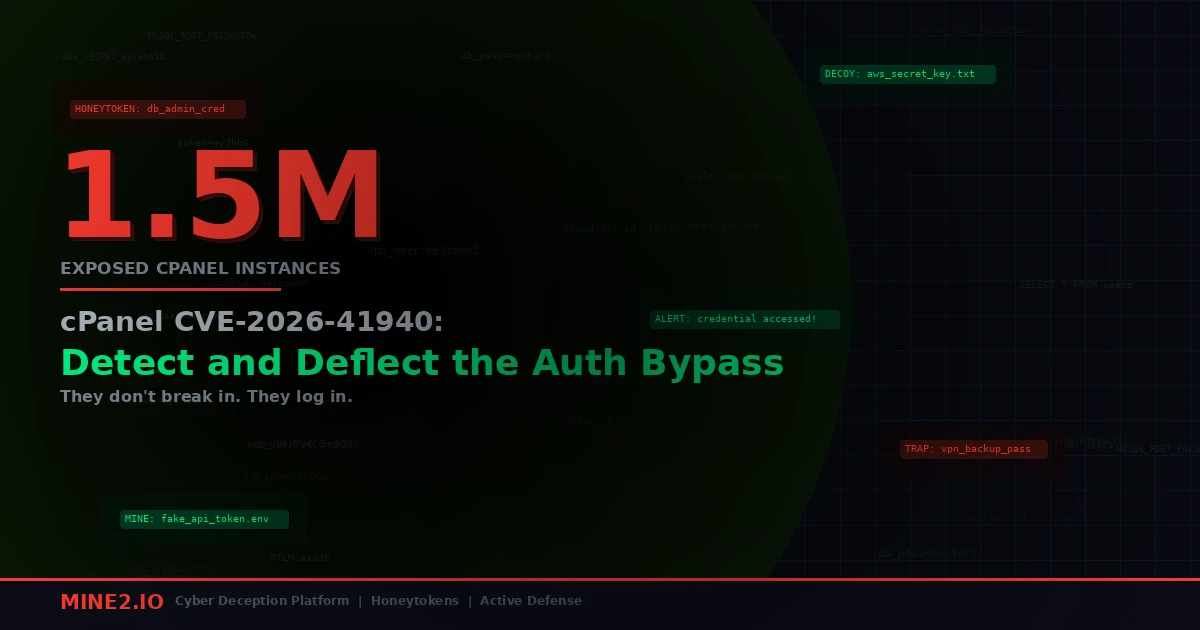
With roughly 1.5 million internet-exposed cPanel instances at the time, this wasn't a niche target — it's the connective tissue of a large slice of the small-business web. Providers including KnownHost, Namecheap, and HostPapa ended up temporarily blocking cPanel ports just to buy time to patch. When WatchTowr Labs published its analysis and a proof-of-concept shortly after disclosure, the exploitation curve went vertical: opportunistic actors started dropping Mirai variants and ransomware onto compromised hosts within days.
CRLF injection is one of those classes that feels almost too old to still matter — it's been in the web-security canon for two decades. But it keeps resurfacing wherever code stitches user input into a structured format (HTTP headers, log lines, session files) without normalizing it first. On assessments I've run against management panels, the pattern is depressingly consistent: the authentication check is hardened and well-tested, while the bookkeeping around a failed attempt — the temp file, the retry counter, the audit log entry — gets written with far less scrutiny. CVE-2026-41940 is exactly that anti-pattern. The front door was bolted; the attacker climbed in through the failed-login paperwork. If you maintain anything that parses an authorization header by hand, that's the code path to go re-read today.
Why this is worse than a "normal" critical CVE
A memory-corruption RCE is loud. It crashes things, it trips exploit-mitigation telemetry, it leaves artifacts. An authentication bypass is the opposite — it's quiet by design. The attacker's traffic looks like a successful login because, as far as the application is concerned, it is one.
That's the uncomfortable truth I keep running into on engagements: most of the stack is tuned to catch the break-in, not the log-in. Walk through the usual suspects:
- WAFs see a slightly odd header and a 200 response. The request isn't a SQL payload or an obvious traversal string, so it sails through. (We saw a near-identical "looks legitimate" gap in the FortiClient EMS SQL injection campaign — the malicious request rode in on a trusted channel.)
- EDR lives on the endpoint and watches processes. A forged web session never touches a suspicious binary until the attacker decides to drop one — and by then the foothold is already established.
- SIEM can only correlate what it's fed. A "successful admin login" event is the least alarming line in the log. You won't write a detection rule that fires on success, because success is most of your traffic.
This is the same structural blind spot that lets EDR-killer tooling thrive while deception keeps watching, and it's why hardware-level bypasses like the Cisco IMC authentication bypass are so dangerous: when the attacker becomes a trusted identity, signature-based defenses have nothing left to flag.
The gap between discovery and detection
Here's the window that actually hurt people. Exploitation started February 23. Disclosure came April 28. The patch followed. Then — because this is the real world — a long tail of servers stayed unpatched for weeks more, held back by maintenance freezes, legacy dependencies, or simply an admin who never saw the advisory.
Stack those phases up and you get three separate stretches where defenders were exposed:
- Pre-disclosure — nobody even knew the bug existed.
- Post-disclosure, pre-patch — everyone knew, including the attackers reading the same PoC you were.
- Post-patch, unpatched-in-the-wild — the bug is fixed in theory and live in practice.
Patching only addresses the second and third phases, and only if you move fast. It does nothing for phase one. If your entire security posture depends on a vendor shipping a fix before anyone abuses the flaw, you've outsourced your detection to someone else's disclosure calendar. That's the strategic problem, and it's why I keep pushing teams toward detection that doesn't depend on knowing the CVE number in advance.
Where deception turns the silence into a signal
This is the part attackers hate, and it's the reason I joined a deception company instead of staying purely on the offensive side. Mine2's model doesn't try to recognize the exploit. It plants things an attacker can't resist but a legitimate user would never touch, then waits. The first contact is the alert.
In a cPanel/WHM environment, that looks like:
- Honeytoken admin sessions and cookies. Fake session files and forged admin credentials seeded into exactly the login paths CVE-2026-41940 abused. Any injection or manipulation of those artifacts — the CRLF trick included — trips an immediate, high-fidelity alert. The attacker's cleverest move becomes their loudest one.
- Canary admin accounts. Decoy administrators with realistic names and permissions. No human ever logs into them, so when injected credentials land on one, there's zero ambiguity: that's an intruder, not a sleepy sysadmin. You get the alert before a real account is touched.
- Breach-trap control panels. Decoy WHM interfaces that mimic production closely enough that a post-bypass attacker pokes around in them — burning time while quietly handing you their source IP, tooling, and intended next steps.
- Automated containment. Wire those signals into SOAR playbooks and the response runs at machine speed: block the IP, isolate the service, force a credential rotation, pull the decoy offline. This is the same deception-to-containment loop we used to shut down Active Directory Kerberoasting before privilege escalation.
The key property is timing. Every one of these fires before a patch is even possible — during phase one, the pre-disclosure window where you're otherwise completely blind. A single touch of a honeytoken during those two silent months would have turned "we had no idea" into "we caught it on day one."
And to head off the usual objection: this isn't another noisy tool. A honeytoken has no legitimate reason to be accessed, so a hit is a hit. Mine2 deploys with minimal overhead and effectively zero false positives, and it sits alongside your patching cycle rather than replacing it.
A practical checklist for hosting providers and tenants
If you operate or depend on cPanel/WHM, here's what I'd do this week:
- Confirm you're patched against CVE-2026-41940, and verify it on every host — not just the ones in your inventory spreadsheet. Shared environments hide forgotten boxes.
- Treat the control plane as crown jewels. cPanel, WHM, Plesk, and similar panels are high-value, internet-facing, and chronically under-monitored. Restrict their exposure and put them behind access controls.
- Watch the login flow itself — failed-then-succeeded sequences, anomalous session-file writes, malformed authorization headers. These are the fingerprints of an auth bypass in progress.
- Assume long zero-day windows. Build detection that doesn't need a CVE number. Deception is the cleanest way to get a signal during the blind phase.
- Plant decoys in the paths attackers actually use — admin sessions, credential stores, management consoles — and route the alerts straight into automated containment.
The lesson of CVE-2026-41940 isn't "patch faster," even though you should. It's that speed of detection beats speed of patching when the bug has already been live for two months. You can't always control when a vendor ships a fix. You can control whether an attacker's first step on your infrastructure is silent or screaming.
Don't let the next zero-day spend two quiet months inside your environment before you find out it was there.
Want to see how honeytokens and canary admin accounts close the zero-day detection gap on your own infrastructure? Book a Mine2 demo or explore the cyber deception platform.
Monty
Offensive Security Lead, Mine2
Monty leads offensive security research at Mine2, breaking down how attackers turn vulnerabilities into footholds — and where deception trips them up first.
Recent Articles
Need Security Help?
Protect your organization with MINE2's cyber deception platform.