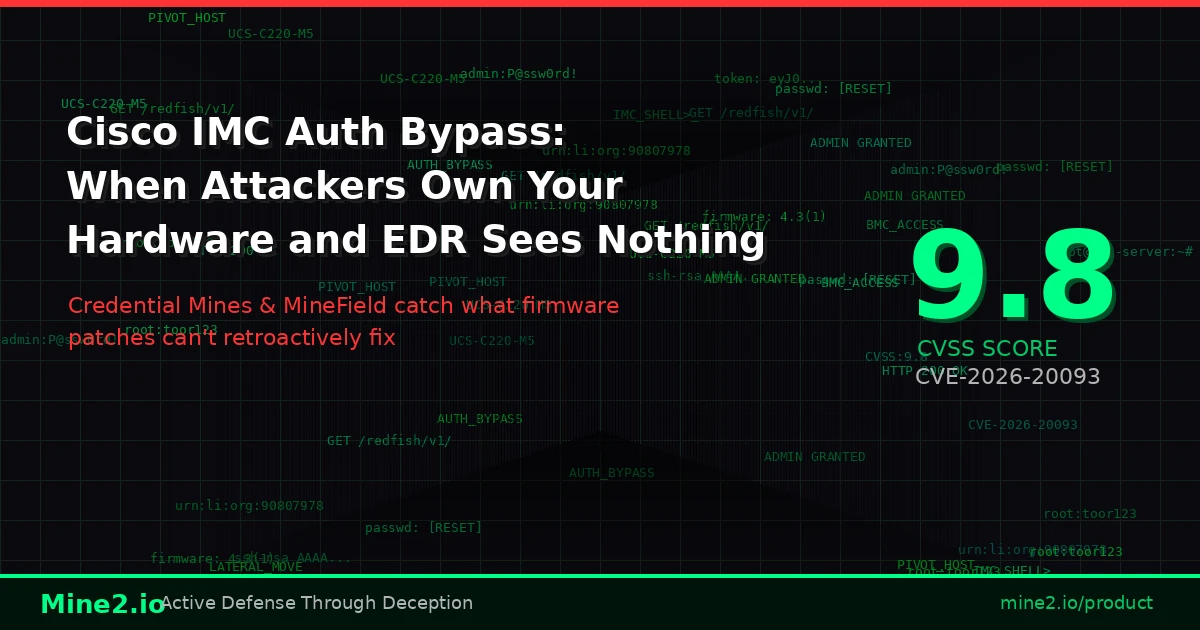
Here's the number your infrastructure team needs in front of them right now: 9.8. That's the CVSS score assigned to CVE-2026-20093, a critical authentication bypass disclosed by Cisco on April 2, 2026, affecting the Integrated Management Controller (IMC) on Cisco UCS C-Series and S-Series rack servers. An unauthenticated remote attacker sending a single crafted HTTP request can silently reset the Admin password, log in as that administrator, and establish complete hardware-level control over every workload running on that physical host — without touching the operating system, without triggering your EDR, and without leaving a trace in any OS-level audit log.
I write exploit chains for a living, and a pre-auth password reset on a baseboard management controller is about as good as it gets for an attacker. The vulnerability has a CVSS score of 9.8 out of 10. No authentication required. No privileges required. No user interaction required. If your IMC management port is reachable from the internet or from a compromised network segment, you're exposed right now.
What CVE-2026-20093 Actually Hands an Attacker
The Cisco Integrated Management Controller is the baseboard management controller (BMC) for UCS rack servers. It runs independently of the host operating system, letting administrators power cycle servers, mount virtual media, access consoles, and configure hardware — all out-of-band, even when the OS is completely offline. By design, it's an always-on administrative backdoor into the physical server.
CVE-2026-20093 is rooted in an Improper Input Validation flaw (CWE-20) in the IMC's password change functionality. By sending a crafted HTTP request to the management interface, an attacker bypasses authentication checks entirely and can reset the password of any user account on the IMC — including the built-in Admin account. Once they hold Admin credentials, they get:
- Full hardware console access: They can drive the server's KVM console as if they're physically present in the data center.
- Virtual media mounting: They can mount a remote ISO image as a virtual CD-ROM — enabling OS re-installation or boot-time persistence that survives OS wipes.
- Power cycle control: They can power down, reset, or force-reboot the host, disrupting workloads on demand.
- Sensor and firmware access: They can reach BMC firmware and potentially establish persistent implants that survive complete OS re-imaging.
- Lateral movement platform: With hardware console access to one UCS server, an attacker can observe network traffic, dump credentials from RAM via direct memory access, and pivot to every VM and container hosted on that physical machine.
Traditional EDR tools operate at the OS layer — they see processes, file system writes, network connections, and registry changes. They're completely blind to activity at the BMC level. When an attacker operates through the IMC, your entire EDR stack has no visibility. Your SIEM receives no OS-level logs. Your DLP sees nothing. The attacker is working in a forensic dead zone beneath every security control you've deployed.
Why This One Is Different
Most critical vulnerabilities of recent months — whether the device code phishing campaign against Microsoft 365 tenants, the Langflow AI pipeline RCE tracked by CISA, or the FortiClient EMS SQL injection — require the attacker to establish a foothold on an endpoint and then operate within the OS environment. That means EDR has at least some chance to observe the intrusion.
CVE-2026-20093 is categorically different. The initial compromise happens at the hardware layer. There's no OS process to detect, no file to scan, no network socket your firewall inspects. The IMC management interface typically runs on a dedicated out-of-band management network (OOBM), often separated from production traffic — but in many organisations, that management plane has grown organically, isn't consistently segmented, and is reachable from jump servers that can themselves be compromised.
Security researcher analysis published by SOCRadar notes that once an attacker has administrative access to a BMC, they effectively "operate below the level of the installed operating system and hypervisor." In a virtualised environment, a single compromised UCS server gives the attacker hardware console access to every virtual machine running on that host — potentially dozens of workloads, including those in different security zones.
The Cisco PSIRT advisory for CVE-2026-20093 confirmed no active exploitation or public proof-of-concept code existed at the time of advisory publication on April 2, 2026. That window, in my experience, is usually measured in days, not weeks. The vulnerability needs only a crafted HTTP request and has a trivially auditable attack surface. Exploit code will emerge. The question isn't whether your IMC will be targeted, but whether you'll detect the post-compromise activity that follows.
Where Traditional Security Tools Fall Short
The standard response to a CVSS 9.8 patch is clear: apply the firmware update immediately. Cisco has released firmware versions 4.3(2.260007), 4.3(6.260017), and 6.0(1.250174) for UCS C-Series M5 and M6 servers in standalone mode. Patching is non-negotiable and has to be your first action.
But firmware patching in enterprise environments isn't instantaneous. UCS server firmware updates require coordinated maintenance windows, workload migrations, downtime planning, and change management approvals. In large environments, completing a firmware rollout across all affected hardware takes days to weeks. The question isn't simply "have you patched?" but "what detects the attacker who exploits the window between disclosure and your last server getting updated?"
More fundamentally, patching CVE-2026-20093 doesn't retroactively detect an intrusion that already happened. If an attacker exploited this before your patch cycle completed, your OS-level monitoring — which saw nothing during the hardware-layer compromise — also won't alert you that the attacker has been quietly studying your environment from the BMC console for the past 72 hours. You need a detection mechanism that works independently of whether the IMC vulnerability has been patched.
Network Access Control (NAC) and out-of-band management network segmentation are important mitigations, but they require knowing precisely which systems are reachable from which segments — and in organisations that have grown through acquisition or organic expansion, that visibility is rarely complete. Vulnerability scanners tell you which servers are unpatched, but they won't tell you that an attacker already exploited the window before the scan ran.
Threat intelligence platforms, SIEM correlation rules, and endpoint agents all share the same limitation: they're invisible to an attacker operating below the OS. You need a detection layer that operates independently of the compromised environment — the same gap we examined in why deception survives EDR killers.
How Deception Catches What Patches Miss
Deception works on a fundamentally different principle than prevention and monitoring tools. Instead of trying to spot malicious activity inside the noise of legitimate operations, it plants irresistible traps — fake credentials, false documents, decoy services — that have no legitimate use. When an attacker touches any of these assets, the alert isn't a probability score or a risk rating. It's a confirmed, zero-false-positive indicator of active compromise.
Mine2's approach to hardware-layer intrusion detection uses three complementary mechanisms:
Credential Mines are realistic fake credentials — usernames and passwords, API keys, SSH private keys, service account tokens — seeded across servers, file systems, configuration directories, and memory-resident stores. An attacker who's gained console access to a UCS server through the compromised IMC will naturally start credential harvesting. They'll read /etc/passwd, look through /home/*/.ssh/, examine application configuration files, and dump credentials from running processes. Every Credential Mine they encounter and try to use triggers an immediate, high-confidence alert. The Mine has no legitimate function — any access is malicious.
MineField deploys decoy TCP services across your internal network — fake SSH daemons, mock HTTP services, simulated database listeners, phantom SMB shares. When an attacker gains hardware console access to a UCS server and starts pivoting — scanning the internal network for lateral movement targets — they'll probe these ports. Every connection attempt to a MineField service generates an alert with the source IP, the destination port, the timestamp, and the full connection metadata. Where a traditional IDS would generate hundreds of alerts on legitimate port scans and require manual tuning, MineField produces only meaningful signals: an internal host scanning your network is an attacker, not a normal user.
Data Mines are convincingly formatted fake documents — financial records, HR files, customer databases, intellectual property — placed in locations an attacker would target once they have console access. If an attacker with BMC-level visibility copies, opens, or exfiltrates a Data Mine, the alert fires with the precise timing and source of the access. This delivers both early warning and the evidence chain required for regulatory breach reporting.
Together, these mechanisms create a detection perimeter at the logical layer above the compromised hardware. Even if an attacker is working via the BMC console with no OS-level footprint, the moment they touch any Mine or any MineField service, their presence is recorded with zero false positives. The alert needs no analyst tuning, no threshold calibration, and no correlation across multiple data sources.
Compliance and Breach Notification Obligations
CVE-2026-20093's severity plus the regulatory landscape make rapid, evidence-backed detection a compliance requirement, not just a security aspiration.
CERT-In 6-Hour Reporting: India's Computer Emergency Response Team mandates that organisations report cybersecurity incidents — including unauthorised access to IT systems, servers, and databases — within six hours of detection. A hardware-layer intrusion that produces no OS-level logs creates a compliance crisis: if you can't detect the intrusion, you can't start the six-hour clock, and you can't provide CERT-In with the required forensic timeline. Mine2's deception alerts come with complete timestamped metadata — the moment of detection, the attacker's source IP, the specific Mine or MineField service accessed — providing the evidence basis for a compliant incident report filed within the regulatory window.
GDPR Articles 33 and 34: Under the EU General Data Protection Regulation, personal data breaches must be reported to the supervisory authority within 72 hours of becoming aware of the breach (Article 33) and, for high-risk breaches, to data subjects without undue delay (Article 34). A UCS server hosting applications that process personal data is a GDPR-relevant system. Mine2 alerts — timestamped to the second, with full network metadata — provide the "awareness" event that starts the GDPR clock and the forensic evidence to demonstrate proportionate response.
India DPDP Act: The Digital Personal Data Protection Act imposes breach notification obligations on Data Fiduciaries whose systems process personal digital data. A hardware-layer intrusion on servers hosting customer data constitutes a potential DPDP breach event. Deception-based detection provides the audit trail demonstrating that the organisation had reasonable security safeguards in place and that detection occurred at the earliest technically feasible moment.
PCI-DSS Requirement 11: The Payment Card Industry Data Security Standard (v4.0) Requirement 11 mandates regular testing of security controls and penetration testing of cardholder data environments. Requirement 11.5 specifically requires intrusion detection systems capable of detecting unexpected files, changes, and suspicious network activity. Mine2's MineField and Credential Mine alerts provide the detection evidence that satisfies Requirement 11.5's intent — with zero false positives, making the compliance audit conversation straightforward rather than adversarial.
RBI and SEBI Directives: The Reserve Bank of India's cybersecurity framework and SEBI's circular on cyber security and cyber resilience both require regulated entities to maintain strong incident detection and reporting. The requirement to report "cyber incidents" — including unauthorised access to critical infrastructure — within prescribed timelines is directly served by Mine2's timestamped, zero-false-positive alert chain.
HIPAA Security Rule: Under the Health Insurance Portability and Accountability Act, covered entities must implement hardware and software activity review procedures to protect the confidentiality, integrity, and availability of electronic protected health information (ePHI). A healthcare organisation running applications that process ePHI on Cisco UCS servers is required to maintain audit controls. Mine2's deception alerts — which operate independently of OS-level logging — fill the audit gap created by BMC-level intrusions that produce no host logs.
Practical Playbook: Responding to CVE-2026-20093
What follows is a structured response combining immediate technical remediation with sustained deception coverage.
Immediate Actions (Within 24 Hours)
Begin firmware inventory using Cisco's Intersight or UCS Manager to identify all UCS C-Series and S-Series servers running IMC firmware prior to the patched releases. Prioritise servers whose IMC management interfaces are reachable from internet-facing networks, DMZ segments, or jump hosts that have been the subject of previous security incidents. Isolate the management plane using network ACLs if immediate firmware patching isn't feasible.
Rotate all IMC admin credentials immediately — not just for the affected servers, but across all UCS infrastructure. CVE-2026-20093 allows password reset without knowing the current credential, so you can't rule out silent compromise in the period between vulnerability disclosure and your detection of this blog post.
Deploy Credential Mines Across All UCS-Hosted Environments (Within 48 Hours)
Seed Credential Mines in the locations an attacker with BMC console access would target: application configuration directories containing database connection strings, CI/CD pipeline credential stores, SSH authorised key files, and in-memory credential caches for service accounts. Mine2's single-click deployment means this can be done for an entire server estate in a single session without performance impact on production workloads.
Each Credential Mine should be realistic enough to be credible — a database password that matches the format and complexity of your real credentials, an SSH private key with the right bit length and comment field. The Mine doesn't need to actually authenticate anywhere; it just needs to look real enough that an attacker wastes time trying to use it, triggering the alert in the process.
Activate MineField on Internal Network Segments
Deploy MineField decoy TCP services on IP addresses and ports an attacker pivoting from a compromised UCS server would logically scan. If your UCS servers host database workloads, deploy MineField listeners on database ports (3306, 5432, 1433) on IP addresses adjacent to your real database servers. An attacker conducting lateral movement will probe these addresses, generating immediate, attribution-quality alerts.
Establish Forensic Chain for Regulatory Reporting
Configure Mine2's alert pipeline to feed directly into your incident response playbook. Every alert should automatically generate a timestamped incident ticket with the full network metadata required for CERT-In and GDPR breach notification submissions. This eliminates the manual correlation step that typically adds hours to the breach notification process — hours you don't have under a six-hour reporting mandate.
Run Tabletop Exercise: BMC Compromise Scenario
Within 30 days, run a tabletop exercise simulating a threat actor with IMC admin access. Map the lateral movement paths available from each UCS server's BMC, identify which Mine deployments would intercept movement along those paths, and validate that your Incident Response team's CERT-In filing procedure is exercised and timing-tested.
Call to Action
CVE-2026-20093 is a reminder that the attack surface is always larger than the OS boundary. Hardware-layer vulnerabilities expose a fundamental gap in EDR-centric security architectures — a gap deception is uniquely positioned to fill.
Mine2 delivers zero-false-positive detection across the full kill chain: from the moment an attacker with BMC access begins credential harvesting (Credential Mines), through their lateral movement across internal segments (MineField), to their attempts to exfiltrate sensitive documents (Data Mines). Deployment requires no agents, no performance impact, and no ongoing tuning.
Patch CVE-2026-20093 immediately. Then make sure you have the detection coverage to catch what the firmware update can't retroactively fix.
Monty
Offensive Security Lead, Mine2
Monty leads offensive security research at Mine2, breaking down how attackers turn vulnerabilities into footholds — and where deception trips them up first.
Recent Articles
The Service Account Blind Spot: How FortiGate Intrusions Expose the Lateral Movement Crisis
13 Million Tickets, One Request: How the Adobe BPO Breach Exposes the Third-Party Credential Blind Spot
When Defenders' Tools Become Attack Vectors: The Management Platform Exploitation Crisis
Need Security Help?
Protect your organization with MINE2's cyber deception platform.