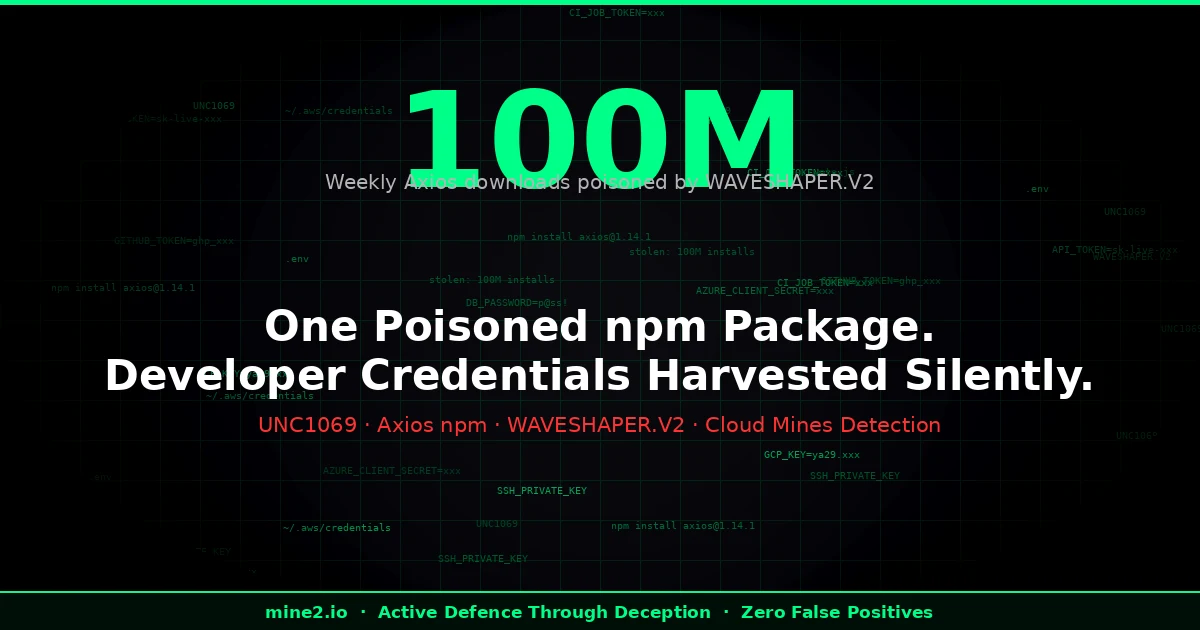
Here's the number every CISO needs to see right now: 100,000,000. That's how many times per week the Axios npm package is downloaded — making it the most widely deployed HTTP client library in JavaScript, present in roughly 80% of cloud and code environments worldwide, according to Wiz research. Between 00:21 and 03:20 UTC on March 31, 2026, that trusted package became a weapon.
In those 179 minutes, North Korean state-sponsored threat actor UNC1069 published poisoned versions of Axios (1.14.1 and 0.30.4) to npm. Each poisoned install silently deployed the WAVESHAPER.V2 backdoor — a cross-platform Remote Access Trojan engineered to harvest cloud access keys, API tokens, and database passwords from developer workstations, CI/CD pipelines, and cloud build environments. The malicious versions were removed within three hours, but during that window automated package managers, Docker builds, and continuous integration runners around the world fetched and executed attacker-controlled code.
I track DPRK crews for a living, and this is no theoretical supply chain risk. It's the most significant open-source package compromise since XZ Utils, and it happened last week.
Why Developer Environments Are the New Perimeter
The Axios attack is the latest confirmation of a strategic shift by nation-state adversaries: the developer environment is now the highest-value initial access vector available.
The reasoning is straightforward. Developers are trusted by design. Their workstations carry elevated network privileges and access to source code repositories, production secrets managers, and cloud provider consoles. CI/CD pipelines run with IAM roles that can provision, modify, or destroy cloud infrastructure. A single compromised developer laptop in a Fortune 500 company can yield AWS keys with a broader blast radius than a phished employee in any other department.
Google's Threat Intelligence Group (GTIG), which formally attributed the attack to UNC1069, documented the social engineering vector: the group's operators approached the Axios package maintainer impersonating the founder of a legitimate, well-known company — including a cloned likeness and fabricated company presence — to win the maintainer's trust before running a targeted credential phishing campaign. It's the same social engineering playbook UNC1069 used in the $285 million Drift exchange heist on April 1, 2026, and the $1.5 billion Bybit theft attributed to the broader DPRK cyber programme in early 2026.
Once the maintainer's npm account was compromised, UNC1069 introduced a malicious dependency called plain-crypto-js into Axios releases. The dependency is an obfuscated dropper. On execution, it deploys WAVESHAPER.V2, an updated version of the WAVESHAPER backdoor previously attributed to this threat actor, which communicates using JSON C2 protocol and supports an expanded command set compared to its predecessor. If you've followed our analysis of the TeamPCP and LiteLLM AI supply chain compromise, the maintainer-account-takeover pattern will look painfully familiar.
What WAVESHAPER.V2 Actually Takes
The malware's credential harvesting behaviour, documented in detail by the SANS Institute, is built for maximum financial yield. Specifically, WAVESHAPER.V2 targets:
- AWS, GCP, and Azure credential files — including
~/.aws/credentials, gcloud application default credentials, and Azure CLI tokens stored on disk - CI/CD environment variables — GitHub Actions secrets, GitLab CI variables, Jenkins build parameters, and CircleCI environment configurations
.envfiles in project directories — where developers routinely store database connection strings, API keys, and OAuth client secrets- Browser-stored credentials — extracted from Chrome and Firefox profile stores on macOS and Windows
- SSH private keys and git credential helpers — enabling repository access and lateral movement into source code management systems
This harvest is exfiltrated to C2 infrastructure via POST requests mimicking legitimate npm registry traffic, making it nearly invisible to network monitoring tools that whitelist npm endpoints.
The impact isn't limited to the infected host. Cloud credentials, by design, are portable — an AWS access key stolen from a London developer's laptop works identically from a server in Pyongyang. Once UNC1069 has valid cloud credentials, the next phase follows the same pattern observed across DPRK intrusions: cloud resource enumeration, lateral movement across cloud account boundaries, and deployment of persistent backdoors into cloud workloads.
Why Traditional Security Tools Are Structurally Blind Here
The Axios attack exploited three layered blind spots that together defeat conventional security stacks.
First: npm install is inherently trusted. EDR tools are tuned to flag suspicious binary execution, lateral movement patterns, and known malware signatures. But npm install is a legitimate, expected operation on every developer workstation. The process tree — node executing plain-crypto-js — is indistinguishable from thousands of legitimate post-install scripts run daily. Unless a vendor had specific signatures for WAVESHAPER.V2 (which most did not in the initial hours), EDR saw nothing anomalous.
Second: Secrets are scattered and unaudited. Most organisations have no inventory of where cloud credentials actually live at rest. Secrets managers store the authoritative copies, but developers routinely cache credentials in .env files, IDE configurations, shell histories, and Docker layer caches. There's no feasible way to know which credentials WAVESHAPER.V2 harvested from which systems — because organisations typically can't enumerate where their secrets reside.
Third: Credential use from attacker infrastructure looks like a misconfigured script. When an attacker uses a stolen AWS access key, the initial API calls often look like legitimate automation: DescribeInstances, ListBuckets, GetSecretValue. Cloud providers don't differentiate between a developer running a script and an attacker running the same commands from a different IP. Without a deception layer, organisations have no reliable way to tell legitimate credential use from attacker-controlled use — especially across the hours or days that typically pass between credential theft and active exploitation. This is the same token-theft-to-exploitation gap we documented in the Anodot and Snowflake SaaS integration breach.
This is the detection gap deception was built to close.
How Cloud Mines and Credential Mines Catch Attackers That EDR Misses
Mine2's approach to the developer credential threat is architecturally simple and operationally certain: plant credentials no legitimate process will ever touch, and instrument those credentials to alert the moment they're used — from anywhere on earth.
Cloud Mines: Fake AWS Keys in Every Pipeline
Cloud Mines are synthetic AWS access key pairs, GCP service account credentials, and Azure SAS tokens that Mine2 generates and distributes throughout the environments attackers target most: developer workstations, CI/CD runner configurations, Kubernetes secrets, Terraform state files, and Docker build environments.
These credentials are cryptographically valid — they pass format validation and look authentic to any harvesting tool, including WAVESHAPER.V2. But they're instrumented at the cloud provider layer: any API call made with a Cloud Mine credential triggers an immediate, high-fidelity alert with the source IP, the exact API call made, and the timestamp. Because no legitimate automation, no approved script, and no human developer ever uses these credentials for real work, there are zero false positives. Every alert is an attacker. The broader case for these tripwires is laid out in our non-human identity honeytokens for API keys piece.
In the context of the Axios attack, an organisation with Cloud Mines deployed across its CI/CD environment would have received an alert the moment UNC1069 operators tried to use a harvested key — not days later when cloud provider anomaly detection fires on billing anomalies, and not weeks later during a threat hunting exercise. The alert arrives within seconds of the first API call, with the attacker's egress IP address, enabling immediate credential revocation and forensic investigation.
Credential Mines: Fake Secrets in Source Code and .env Files
Beyond cloud credentials, Mine2 deploys Credential Mines — synthetic database connection strings, API tokens, and service account passwords — embedded in the locations WAVESHAPER.V2 specifically targets: .env files in project directories, configuration files in home directories, and shell history files.
These mines serve a dual purpose. First, they act as canaries: any exfiltration tool that sweeps .env files harvests the mine alongside real credentials. Second, when the attacker tries to use the stolen credential against a real or monitored endpoint, Mine2's detection triggers. For database mines, connection attempts from unknown hosts are flagged immediately. For API token mines, any call to the associated endpoint from a non-approved source generates an alert.
Crucially, Credential Mines require no changes to production code. They're deployed as additional files in existing directories — single-click via Mine2's deployment interface, zero performance impact on running applications. It's the same model we walked through in our supply chain honeytokens deep dive.
MineField: Catching the Lateral Movement Phase
After credential theft, WAVESHAPER.V2 enables interactive remote access via its RAT capability. Attackers using that access will enumerate the internal network — scanning for database ports, internal APIs, and administrative interfaces. Mine2's MineField deploys decoy TCP services across the internal network: fake SSH listeners, fake database ports, fake RDP endpoints.
Any connection attempt to a MineField decoy from a compromised internal host generates an immediate alert with the source host identity. This catches lateral movement the moment it begins, before the attacker reaches a secondary target — providing the forensic timeline required for breach notification compliance.
Compliance Implications: Why Detection Timing Is Now a Legal Issue
The Axios attack shows why detection latency isn't merely an operational concern — it's a regulatory liability.
CERT-In 6-Hour Reporting (India): India's Computer Emergency Response Team mandates that covered entities report cybersecurity incidents within six hours of detection. An organisation that discovers stolen credentials were used three weeks after the Axios compromise has technically complied with the detection-to-reporting window — but the reputational and regulatory exposure of a three-week breach dwell time far exceeds the reporting obligation. Cloud Mines reduce attacker dwell time to minutes by generating detection on first credential use, not first anomaly detection.
GDPR Articles 33 and 34 (EU): Data controllers must notify supervisory authorities within 72 hours of becoming aware of a personal data breach. The operative phrase is "becoming aware." Organisations that deployed Cloud Mines and received real-time alerts on credential use can establish a precise awareness timestamp for regulators. Organisations without deception coverage can't demonstrate when they first had material reason to believe a breach had occurred — a distinction that directly affects penalty exposure under GDPR's tiered fine structure.
India DPDP Act: The Digital Personal Data Protection Act imposes breach notification obligations on data fiduciaries, with penalties scaled to breach severity and notification timeliness. Cloud Mine alerts generate an audit trail — timestamp, attacker IP, credential accessed, API calls made — that forms the evidentiary basis for a defensible regulatory response.
PCI-DSS Requirement 11: Payment card data environments must implement intrusion detection and monitoring for all access to cardholder data. Cloud Mines and Credential Mines satisfy Requirement 11's mandate for detection mechanisms across sensitive environments, with audit trails that satisfy Requirement 10's logging obligations.
RBI/SEBI Directives: Financial entities regulated by the Reserve Bank of India and Securities and Exchange Board of India are subject to increasingly prescriptive cybersecurity frameworks that require demonstrable detection capabilities and breach reporting within defined windows. Mine2's detection timestamps and forensic data provide the documentation these frameworks require.
HIPAA Security Rule: Covered entities must implement technical safeguards to detect and audit access to electronic protected health information. Cloud Mines deployed in cloud environments that process or store ePHI provide continuous monitoring coverage with complete audit trails — satisfying both the Technical Safeguard requirements and the Audit Control standard.
Practical Playbook: Five Steps to Close the Developer Credential Gap
Security teams responding to the Axios attack — or preparing for the next one — should prioritise the following:
1. Rotate all credentials that could have been exposed. Any AWS access key, API token, or database password stored in .env files, CI/CD environment variables, or developer home directories on systems that installed Axios between March 31 and April 1, 2026, should be treated as compromised and rotated immediately. Priority credentials: cloud provider access keys, production database passwords, OAuth client secrets, and SSH keys stored outside hardware security modules.
2. Deploy Cloud Mines in CI/CD pipelines within 24 hours. The mean time to exploit stolen CI/CD credentials is measured in hours, not days. Planting fake AWS credentials in GitHub Actions secrets, GitLab CI variables, and Jenkins environments provides immediate detection coverage for the use of any credential harvested from those environments — real or planted.
3. Audit and inventory .env file locations across the developer fleet. WAVESHAPER.V2 specifically sweeps project directories for .env files. A one-time inventory of where these files exist, combined with Credential Mine deployment in those locations, converts an unmonitored attack surface into a detection layer.
4. Enable MineField on build servers and developer workstations. Compromised build servers are the pivot point for lateral movement into production. MineField decoys on internal build infrastructure catch the reconnaissance phase — port scanning, service enumeration — before attackers reach production targets.
5. Establish a credential alert runbook before the next incident. Cloud Mine alerts arrive with the attacker's IP, timestamp, and specific API calls. Security teams need a pre-defined runbook to action this alert within minutes: credential revocation, forensic capture of the attacker IP, CERT-In notification preparation, and cloud provider abuse reporting. Playbooks written after the alert fires add avoidable hours to response time.
The Strategic Takeaway
The Axios npm attack is a textbook demonstration of why perimeter-focused and endpoint-focused security architectures fail against sophisticated supply chain adversaries. UNC1069 didn't exploit a vulnerability in Axios. They exploited the trust developers place in the packages they install — and the structural inability of conventional security tools to tell legitimate package execution from attacker-controlled code running inside a trusted process.
The only reliable detection mechanism for credential theft that occurs within a trusted process is monitoring what happens to the credentials after theft. Cloud Mines and Credential Mines do exactly that: they make credential theft observable at the point of use, with zero false positives, regardless of how the credential was stolen or from which system.
In an environment where 100 million package installs happen every week and a single poisoned version can silently harvest credentials from tens of thousands of systems within hours, waiting for EDR signatures isn't a strategy. Active defence through deception is.
Stop relying on tools that can't see inside trusted processes. Deploy Cloud Mines across your developer environments and CI/CD pipelines in under 60 seconds — with zero performance impact and zero false positives. See how Mine2 works →
Riya
Principal Threat Researcher, Mine2 Labs
Riya tracks active threat campaigns and APT tradecraft at Mine2 Labs, translating real-world attacker behaviour into practical detection ideas.
Recent Articles
One Token, Dozens of Victims: How the Anodot SaaS Integration Breach Rewrites the Third-Party Risk Playbook
18,000 Routers, 120 Countries: How APT28's DNS Hijacking Campaign Renders Your M365 Credentials Worthless
React2Shell CVE-2025-55182: 766 Next.js Hosts Breached in Automated Credential-Theft Wave
Need Security Help?
Protect your organization with MINE2's cyber deception platform.