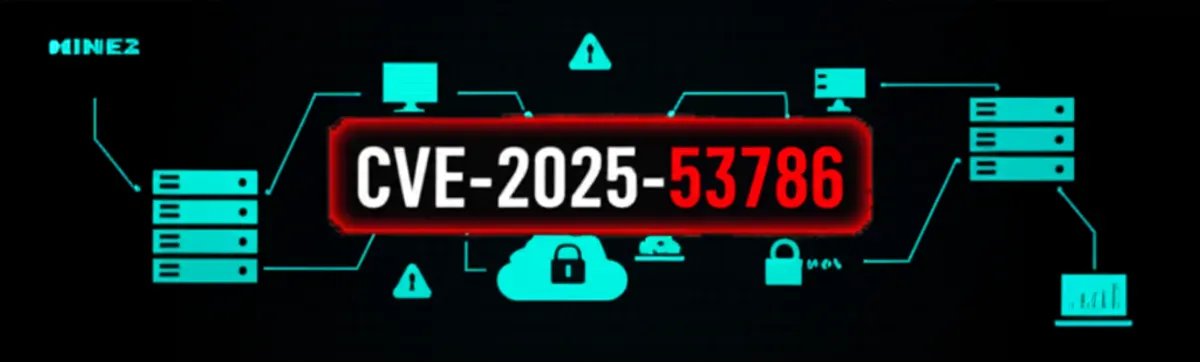
Urgent: CVE-2025-53786 – A Critical Hybrid Exchange Vulnerability That Could Lead to Total Domain Compromise
On August 6, 2025, Microsoft disclosed a critical security vulnerability affecting organizations running Hybrid Exchange Server environments. Designated CVE-2025-53786, it's an Elevation of Privilege (EoP) flaw carrying a CVSS score of 8.0. The risk it creates is total domain compromise, with both on-premises and cloud-hosted infrastructure on the line.
Leave it unpatched and an attacker can use it to gain undetected access across both your on-premises and cloud environments, ending in a full compromise of your domain. This one belongs at the top of your queue today.
🔍 The Trust Boundary That Breaks
The flaw lives in setups where on-premises Exchange servers are wired into Exchange Online in a hybrid configuration. I spend my days chaining exactly this kind of weakness, and what makes CVE-2025-53786 nasty is that it abuses a trust relationship you can't easily see.
The root cause is improper authentication handling (CWE-287), specifically the insecure sharing of service principals between on-premises Exchange and Exchange Online.
Here's how the chain runs:
- The attacker needs admin-level access to the on-premises Exchange server first.
- With that foothold, they manipulate the shared service principal credentials.
- From there they can forge tokens that Exchange Online accepts as legitimate.
- Those tokens let them impersonate Exchange Online services.
- They gain undetected access to sensitive cloud-hosted mailboxes and services, slipping past Microsoft 365 audit logs.
- Stealthy persistence is the payoff, keeping them hidden for hours before anyone notices.
That step where on-prem admin becomes a forged cloud identity is the whole game. It's the same privilege-to-impersonation jump we broke down in the EPM poisoning and Windows RPC privilege escalation writeup, just played across the hybrid boundary instead of inside one host.
⚠️ Versions in Scope
These Exchange Server versions are affected:
- Exchange Server 2016 CU23
- Exchange Server 2019 CU14
- Exchange Server 2019 CU15
- Exchange Server Subscription Edition (RTM)
🛠 What to Do Right Now
Microsoft has shipped security guidance and patches that need to go out immediately.
Apply the latest security updates
Install the April 2025 Hotfix Updates or a later Cumulative Update on every affected server.
Move to the dedicated Exchange Hybrid app
Replace the legacy shared service principal with Microsoft's dedicated hybrid authentication model.
Reset cloud credentials
Use Microsoft's Service Principal Clean-Up Mode to reset keyCredentials and lock the environment down.
Confirm your configuration is compliant
Run the Microsoft Exchange Health Checker to verify your hybrid environment is secure and compliant.
Secure legacy servers
Disconnect unsupported or internet-facing Exchange/SharePoint servers from public access immediately.
📢 CISA's Emergency Directive
In response to this vulnerability, the Cybersecurity and Infrastructure Security Agency (CISA) issued an emergency directive for U.S. federal agencies. Agencies had to patch and reconfigure their affected hybrid Exchange environments by:
📅 August 11, 2025, 9:00 AM EDT
Private organizations aren't bound by that deadline, but the risk is exactly the same. Don't read "not mandated" as "not urgent."
✅ The Short Version
- Severity: High (CVSS 8.0)
- Risk: Potential total domain compromise across on-premises and cloud environments
- Exploitation likelihood: Highly likely, even without confirmed active exploitation
- Action: Patch immediately, modernize hybrid authentication, and run thorough access audits
🔒 Bottom Line
If you're running a hybrid Exchange deployment, treat CVE-2025-53786 as a critical emergency.
➡️ Apply Microsoft's patches without delay ➡️ Follow the configuration guidance to harden hybrid authentication ➡️ Review your authentication setup now, before someone else does it for you
Don't wait for an incident to teach you where the trust boundary leaked.
🛡 How Mine2 Looks at This
The reason this attack stays quiet is that forged tokens look like legitimate service activity. Traditional controls struggle to flag an authentication bypass that uses valid-looking credentials, which is the same blind spot we keep hitting in token-theft cases like device code phishing and OAuth token abuse and the BeyondTrust PAM breach.
Mine2's cyber deception platform helps you:
- Detect unauthorized access attempts in hybrid environments
- Monitor service principal abuse through honeytokens
- Spot lateral movement between on-premises and cloud systems
- Generate high-fidelity alerts the moment an attacker touches a decoy credential
The trick is simple: an attacker hunting for service principals to abuse can't tell a real one from a planted one, and the planted one only ever gets touched by someone who shouldn't be there.
👉 See how Mine2 protects hybrid environments with deception that fires on first contact.
📚 Sources
Monty
Offensive Security Lead, Mine2
Monty leads offensive security research at Mine2, breaking down how attackers turn vulnerabilities into footholds — and where deception trips them up first.
Recent Articles
Need Security Help?
Protect your organization with MINE2's cyber deception platform.