In early October 2025, a newly emerged cybercrime group calling itself the Crimson Collective disclosed a massive breach of Red Hat's consulting GitLab instance. They claimed to have stolen 570GB of compressed data from over 28,000 repositories. The haul included sensitive Customer Engagement Reports (CERs) for roughly 800 organizations across finance (Bank of America, JPMorgan Chase), tech (IBM, Cisco), government (U.S. Navy, NSA), and healthcare (Mayo Clinic). Red Hat confirmed the incident on October 2, stressing it was isolated to a consulting-specific GitLab setup, not their broader services or supply chain.

The ripple effects run deep. Attackers allegedly pulled hardcoded secrets out of those CERs—API keys, database URIs, VPN configs—and used them to pivot into client infrastructures. Belgium's cybersecurity center issued a high-risk advisory and pushed for credential rotations. For Red Hat customers, the response turned into a scramble: audit logs, rotate tokens, scan repos. None of this was inevitable, though. Catch the intruder early and a supply-chain catastrophe shrinks down to a single contained alert.
A Group That Went From Graffiti to Extortion in a Week
Crimson Collective showed up on September 24, 2025, opening a Telegram channel and claiming a Nintendo defacement. The next day, they hit Claro Colombia's telecoms. Then, on October 1, came Red Hat. That's a fast climb from vandalism to industrial-scale extortion.
The pattern looks a lot like consulting breaches I've worked through before. Unknown initial access—maybe phishing, maybe a supply-chain bug—leads to quiet data harvesting across repos. From there, attackers sift CERs for the good stuff: infrastructure diagrams, vulnerability assessments, and above all secrets like cloud keys and DB strings. GitGuardian's research calls this "secrets sprawl," and the numbers are ugly: internal repos hold 8-10x more embedded credentials than public ones, usually leftovers from proof-of-concept code where consultants hardcode to move fast.
Red Hat moved quickly, but reactively—remediation underway, no evidence of wider impact. The real exposure? Lateral moves into client networks that turn one breach into hundreds. When the group ignored private extortion overtures and went public, it laid bare how consulting firms aggregate credentials like a digital vault. That makes them a prime target. We've watched the same dynamic play out in the Toyota GitHub credential exposure, where one hardcoded key in the wrong repo opened a customer database.
The Secrets Trap: Why Nobody Noticed
Firewalls, endpoint tools, even secrets scanners all wait on known threats or scan after the fact. In Red Hat's case, the attackers held valid access and exfiltrated quietly for weeks. The hardcoded secrets sat undetected until the Telegram post. No behavioral anomaly flagged the bulk repo clones. No tripwire caught the credential mining.
That's the blind spot. Consulting engagements bury client PII and keys in shared repos, and without proactive lures, an intruder just roams. The result is a cascade: one firm's compromise quietly unlocks doors at Boeing, Verizon, or the DoD.
How Mine2 Breaks the Cascade
Cyber deception assumes the breach already happened and baits the attacker with fakes. Mine2.io plants honeytokens, canary credentials, and breach traps directly into GitLab, CERs, and downstream systems. Here's where Crimson Collective would have tripped:
-
Honeytokens in CERs: Fake API keys, DB URIs, and VPN configs seeded across repos. Any query or export fires a silent alert. Attackers "mine" decoys and reveal themselves mid-harvest, well before they touch a real Bank of America key.
-
Canary repos for consulting: Decoy GitLab instances that mimic client projects, loaded with bogus infrastructure diagrams. Every lateral move into a trap gets logged, which buys time to isolate.
-
Breach traps in pipelines: Fake CI/CD configs wired to sham cloud access. If an attacker tests a "stolen" key, it routes to a monitored sinkhole that captures their IPs and tactics without putting production at risk.
Picture it in motion. On initial access, a honeytoken touch alerts SecOps in minutes. Real credentials auto-rotate. The GitLab instance gets contained. No 570GB exfil. No global advisories. For Red Hat customers, Mine2 ties into SOAR to push deception downstream too, like fake tokens riding along with rotated AWS keys.
Unlike a noisy scanner, this produces zero false positives, because only malice ever touches the bait. Deployment stays non-disruptive and automates across all 28,000+ repos. If you want to see the mechanics, the Mine2 product page walks through how the tokens get seeded.
From Reactive Rotations to a Posture That Holds
The Red Hat breach is a blunt reminder that supply chains aren't just code—they're webs of credentials. You have to treat consultants as an extension of your perimeter. The immediate steps are obvious: rotate every shared token, scan for sprawl. The longer play is to layer in deception so the next intrusion announces itself.
If you're a consulting customer, mandate honeytokens in proof-of-concept work. If you run a firm like Red Hat, segregate repos and enforce customer-side secrets managers. The same lesson shows up across supply-chain attacks where seeded honeytokens flip the attacker's advantage and in the BPO supply-chain Adobe breach. And it rhymes with how leaked privileged credentials sank Uber back in 2022. With Mine2, a breach becomes an intel opportunity—attackers expose themselves and you respond first.
Crimson Collective's haul could fuel attacks for years. With deception in place, it could have been a dud: fakes leading to dead ends. Don't wait for your own Telegram moment to find out what's in your repos. Book a Mine2 demo and build the traps before someone else maps your secrets.
Kabir
Incident Response Lead, Mine2
Kabir leads incident response work at Mine2, dissecting breaches after the fact to show where earlier detection would have changed the outcome.
Recent Articles
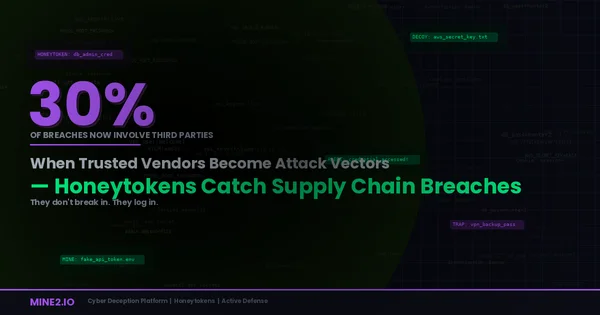
When Trusted Vendors Become Attack Vectors: How Honeytokens Catch Supply Chain Breaches
Toyota's Sensitive Repo Was Publicly Exposed for 5 Years Before They Knew! How Can You Be Iron Sure to Not Repeat the Mistake?
We Will Ensure What Happened with Uber in 2022 Won't Happen to You
Need Security Help?
Protect your organization with MINE2's cyber deception platform.